Showing posts with label DX. Show all posts

Wednesday, February 4, 2026

Beverage Controller

Remote and controller boxes laid 
out for wiring.
With these Beverage antennas, I needed a way to switch between them quickly and easily. 

Taking a cue from the K9AY Controller, I didn't want to just hook up a rotary switch. I wanted a push-button controller. Plus, a lot of the time I'm remotely operating my station on FT8 from the house, I wanted that capability as well. 

Design

I planned for at least three Beverages, maybe more. Plus I had the K9AY loops. That's at least four antennas, having a fifth would give me a spare.

The buttons and indicators needed to be convenient to operate, up front in the station without being intrusive. 

The receiving antenna feed lines also needed to terminate at the Single Point Ground (SPG). Best option was a remote relay box to do the switching, and a small controller box containing the buttons and indicators.

Test positioning the Controller
Adding a serial port to the controller allowed the antenna selection to be interrogated and selected. I already the PIC16F18426 chips on hand. This 14-pin device has a built-in EUSART. A MAX232 would handle the RS-232 level conversion.

Construction

I found a small Bud box in my junk box for the remote. I ordered a die-cast aluminum box for the controller. It was small, but it fit very nicely up under the shelf supporting the P3. Convenient and unobtrusive.

Remote mounted on SPG
The remote has six RF connectors - four F-connectors for the Beverages, one BNC for the K9AY, and another BNC to connect to the K3. SPDT relays are used. When selected, the relay connects the antenna port to the K3 port. When unselected, an appropriate resistor connects across the antenna port. ( I used 82-ohm resistors for the F-connectors, 51-ohm for the BNC -- closest I had to 75 and 50 ohms, respectively )

I used 12 V relays. Unlike the KK1L 2x6 Antenna Switch, I didn't want to activate each relay with a separate line for +12 V. Instead, I sent +12 V to the remote box on a common conductor and then returned a signal for each relay to be grounded by the open drain pins on the PIC. 

This lead to a design problem. The PIC doesn't support true open drain outputs. Each pin is clamped to Vdd, which in this case is +5 V. That left about 6 or so volts across each relay, pulling them all in. 

To solve this, I added 2N3904 NPN transistors to the relay box as open collector drivers for each relay. A 3 K resistor connects the base of each transistor back to the PIC. Instead of a logic 0 activating the relay, a logic 1 does the same job.

The controller box is really tight. I borrowed five switches from the K1EL Keyer. The LEDs and switches barely fit. The controller itself is simple. Five RA port pins connect to the pushbuttons. Five RC port pins drive the LED indicators and NPN relay driver. One RA pin and one RC pin communicate with the serial port. 

Changing the sense of the relay switching required re-wiring of the LEDs. Before, they were tied to +12 with the cathode of each LED brought to ground by the PIC. Except that didn't work due to the design problem. Instead the cathodes went through a common 330 ohm resistor to ground, and the anodes were connected across the activation lines for each relay.

Debugging

I debugged this design in parts, starting with the controller box, then the relay box separately. Once I connected them together, I found the design problem that required much re-wiring. 

The button selection worked great. The serial port has been more of a problem. While the PIC receives commands correctly, it doesn't appear to transmit anything at all. It is a puzzlement. 

Tuesday, December 30, 2025

Beverage(s)

View 175 feet down NW Beverage.
My initial experience with the 2024 ARRL 160m contest demonstrated a serious noise issue on Ward Mountain. The Inverted-L showed an S4 noise level. I needed low-noise receiving antennas.

I'd had some success with the half-size K9AY loops at the Gwinnett station. But I could use something better.

At contest stations such as NQ4I or WW4LL, I've had the opportunity to use Beverage antennas. But  never at my home station.  I planned to change that. 

The Plan

Having a bit of acreage, there's room for several beverages.The key directions were to the NorthEast (NE), SouthEast (SE) and NorthWest (NW). 

For 160m Beverages, many recommend at least 550 feet of wire, minimum. This is just a bit over one wavelength long. ( Technically, using a velocity factor of 95%, one wavelength of wire should be 520 feet at 1.8 MHz ) Since they don't make spools of 550 or 520 feet of wire, a 500 foot spool should be sufficient. 

Wire is expensive. A 500 foot spool of stranded 14 gauge THHN wire is $78 at Home Depot. 

Beverage antennas are pretty simple. The long piece of wire is fed against ground at both ends. The near end uses a matching transformer to adapt the nominal 500 ohm impedance of the Beverage to a feedline. The far end contains a terminating resistor. 

Beverage terminators (above) and
transformers with F-connectors (below)
Terminator Boxes

I built five Beverage terminator boxes using a 470 ohm 2W resistor (OY474KE Ceramic composition resistor) and a 75v gas discharge tube.

These parts fit snugly in a small plastic box. Thumbscrews make for easy connection to the antenna and ground rod.

Transformer Boxes

500:75 ohm transformer
Beverage transformers are wound on BN-73-202 cores. Primary is 3 turns using red wire-wrap wire. Secondary is 8 turns yellow wire-wrap wire. The primary and secondary are separated using cut off bits of plastic stirring straws. The 3:8 turns ratio is a good match for 75 ohm coaxial cable used to feed the antenna. 

Transformer assembly progression
Transformers are housed in the same small plastic boxes. An F connector jack supplies the transformer primary. Transformer secondary connects to thumbscrew posts with another 75 V gas discharge tube across them. There is no common ground connection between the primary and secondary -- this avoids noise pickup from the feedline. 

Thumbscrews connect to the antenna and ground rod at the feed point.

I built four transformers initially. The small plastic boxes work necessitated a bit of ingenuity to get everything in place. 

Erecting

Single wrap traps wire
Installed insulator
Being surrounded by forest, the Beverages are suspended from trees aligned with the reception path. Screw-in electric fence insulators are used to support the antenna about 8 feet off the ground. 

A rope around a tree supplies modest tension for the wire at each end. This leaves the ends relaxed to connect to the transformer or terminator boxes and ground rods. 

The technique for installing the beverages is straightforward, I start by locating the feed point transformer near a supporting tree and mounting an insulator there. Once the ground rod and tension rope are installed, it's a matter of going from tree to tree installing insulators and hooking the wire. This continues until you reach the end of the wire, where the ground rod, terminator box and tension rope are located. 

Terminator installed
Tension connection
At the transformer and terminator, the wire to the ground rod zig-zags a bit to take up the slack from the insulator. This keeps the plastic box from flapping around in the wind.

Every attempt is made to keep the Beverage straight toward the target heading. A bit of direction change to make supporting trees is tolerable. I used the iPhone Compass app to keep me on heading. 

At my location, the terrain slopes a bit. For the NW beverage, after the first 175 feet, the drop-off is quite gradual. 

The NE beverage is another story. Terrain drops about 10 feet in the first 200 feet, but the last 300 feet drops about 80 feet. The beverage terminator ended up in the bottom of a deep ravine. Navigating the slope was quite difficult. Rocks, branches and other debris on the forest floor made for tricky footing. Be careful out there.

Feed Line

I caught a deal on some RG-6. I found 700 feet on a spool for less than $20 at the Dalton, GA hamfest. RG-6 is cheaper than stranded wire. A 500 foot spool is $50 at Home Depot. This 75-ohm coax makes for a good receive antenna feedline. It's cheap, low-loss and easy to match.

Performance

Only have a little experience with these antennas. NE Beverage has been up a month, and the NW Beverage a week. 

Performance is amazing. 

On the 160m Inverted-L, there's typically S4-5 noise. Noise level on the Beverage antennas varies depending on the time of night, but is typically 1-2 S-units lower. 

More importantly, signal levels are stronger. If I watch the Elecraft P3 panadapter, switching from the Inverted-L to one of the Beverages, the noise level drops somewhat, but the signals rise above even more. Sometimes, when there are no visible signals on the Inverted-L, many are Q5 copy on a Beverage.

Further, switching from one Beverage to the other can have a dramatic effect on signals. Sometimes, signals that are strong on one are inaudible on another. Other times, signals are about the same.

In short, the Beverage receive much better than the Inverted-L. During the recent Stew Perry TBDC, I listened on the Beverages almost exclusively. 

They work.

Monday, September 30, 2024

Cycle 25 is Kicking Butt

Don't know why I didn't write about this when it happened.

August 9th, the daily Sunspot Number (SSN) was 382. That seemed enormously high. I couldn't remember a single time when the SSN was that high. So, I did some digging.

I downloaded all the SSN data, converted into an Excel spreadsheet and did some analysis. The SSN hasn't been that high since 1991. That's 33 years ago!

The SSN has only been this high a total of ten times in my lifetime (since February 1961) -- Five in 1979, Twice in 1989, and Three times in 1991. 

Of course, none of this compares with Cycle 19, where daily SSN values were well over 500 for many days. But those values all happened 1956-1959, well before I was born.

Cycle 25 is shaping up to be much better than Cycle 24, which was really lousy, and possibly better than Cycle 23.  The smoothed SSN has already exceeded the maximum value for Cycle 24, and it is far from over. 

We've already seen a huge change in the bands in the last couple of years. 20m is open 24 hours, and 15m much of that time. 12 and 10m is open every day. I'm hoping we might see some 6m F2 openings. Enjoy it while you can. We should have two more years of these conditions before the cycle starts back down.

Friday, June 28, 2024

The Great LoTW Outage - Continues.

Update July 1, 2024. LoTW is back up! It is running slow, but it is available. Thank goodness.

--

When I wrote the article back in May, I hardly thought that LoTW would be down a month later.

Sadly, the outage continues. 

My suspicions were correct, however, that this was something more than a simple networking problem. The ARRL has since admitted their network was viciously and uniquely hacked. I can certainly understand their caution to make sure that every system linked to LoTW is given a clean bill of health before turning the system back on.

Earlier this week, on Tuesday there was apparently a brief period of time when LoTW was accessible. A couple of my ham buddies managed to upload some contacts. They'll have to wait for confirmations when the rest of us can get in.

I do hope it is soon. I'm really missing this service.

Monday, May 27, 2024

The Great LoTW Outage

May 16th, there was an issue with Logbook of The World (LoTW). I could not load the main page at all -- receiving an error indicating the server wasn't responding.

That's pretty normal stuff, actually. There are dozens of problems that can result in this kind of error, so I wasn't surprised. I figured the ARRL staff would address it quickly. But, after much of the day, I was still getting the error. 

So, I sent a message to lotw-help@arrl.org, informing them that the web site wasn't responding, kindly asking when they expected it to be back up. I mentioned I was surprised there was no notice of the outage on the ARRL.org web site.

Later that day, the ARRL put up a notice that there was a service disruption involving access to the network, and that it affected LoTW and the ARRL Learning Center. They even updated it the next day, addressing concerns users had over information privacy.

But then, nothing happened. Not until May 22nd, when they updated the notice without really adding any information. 

Now, part of this delay may be due to the fact that much of the ARRL staff were all out at the Xenia Hamvention. But, that was a week ago.

What gives? Sure, networking problems. Honestly, though, as a computer professional, networking problems generally don't take more than a week to solve. I'm beginning to suspect there's something more than the ARRL hasn't told us, but I can't be sure.

I'm really missing access to LoTW. In the last 20 years, it has really become central in my enjoyment of the hobby. I do hope I'm wrong, and that ARRL manages to fix this problem soon.

Tuesday, May 21, 2024

Fixing up the Cushcraft A50-3S

A50-3S standing tall and
straight next to the house.
Last year, I moved the A50-3S out of the yard and up next to the house. I used a 19 foot mast made of two pieces of EMT. While putting it up the reflector bumped against the roof and turned askew about 15 degrees. 

Never the less, it worked well. I worked a few Europeans and several South and Central American using this antenna.

Still, it needed a bit of work. A one-piece mast would be better, and I could straighten out the reflector when I swapped masts. A bead balun at the feed point wouldn't hurt either. 

So, I researched these. You would not believe what a 20 foot piece of 1 1/2" 0.058 wall aluminum tubing goes for these days. A few years ago, I purchased a 12 foot piece of 2" diameter 1/4" wall 6061-T6 tubing for my gin pole. It was about $150, which seems right for such a substantial piece of metal. 

But 20 feet of the thinner mast? They quoted me $500! If I went with the 1/4" wall, well that was manufactured with a different process -- extruded instead of rolled, so it would be $250. Ridiculous. There had to be another solution. 

I did have 20 feet of mast in two 10 foot pieces. This was from an earlier experiment. I had an old Butternut  HF4B that I had rebuilt, and was hoping to erect in Fulton County. I bought two pieces of Rigid Metal Conduit (RMC) for this purpose. 

EMT and RMC are easily found at your local Home Depot. But it isn't exactly what you would call structural. EMT is design to bend. Easily. I have had some success using it as masting for very small, light antennas. The two pieces I used on the A50-3S lasted for over eight years, plus the several years holding up a 19 element 2m boomer Yagi. RMC is more substantial, and comes with threaded couplings to connect them together. 

Two pieces of 10 foot RMC was $30 a pop, so this wasn't a cheap experiment. Even with the coupling tightened all the way down, the 20 feet of mast had a substantial wobble in the top section. I tried inserting a solid piece of HDPE. That helped, but not enough to hold up the HF4B. 

It occurred to me that this might work with the A50-3S, even with the wobble. The A50-3S is held upright by a wall bracket at the eve of the house, well above the wobbly union. I just needed the vertical support, and not so much lateral rigidity. Besides, I already had $60 invested.

First order of business was to find the doggone things. I put them away three parsonage moves ago, and had hidden them well. They were hiding in my basement. After that, I had to locate the piece of HDPE, which I found in another box. 

It all came together this week. My youngest daughter Lauren helped me to lower the existing A50-3S and mast to the ground. Off came the antenna and the feed line, and the old mast was disassembled and put away. Then I coupled the RMC together with the HDPE stiffener and taped the coupling joints against any water intrusion. With the A50-3S mounted on the new mast, the reflector was aligned with the rest of the elements. 

For a balun, I used five snap-on ferrite beads. I measured these at about 100 ohms resistive at 50 MHz. Five conveniently fit on the 9913 coax from the driven element to the mast, so that is what I used. 

A50-3S facing South East.
Swinging the new mast up into place without bashing the antenna against the house took some patience. The RMC mast is much heavier than the two pieces of EMT. Once vertical, I positioned the mast in the eve bracket and loosely connected the u-bolt clamp. Both my daughter and I lifted the assembly to the top of the railing. From there, I tightened the bracket to eliminate play, but loose enough to allow the antenna to rotate. I used a couple of extra 1/4" nuts as jam nuts so the bracket could not tighten or loosen. 

The antenna is easily Armstrong rotated from the base. Eventually, I'll mount a rotator on the top of the railing and retire my arms.

A quick SWR check showed a 1.2:1 SWR at 50.313 MHz. The antenna is pretty broad. Minimum SWR is around 50.8 MHz at 1.07:1. I suppose I could mess with the matching network to get a better match on the FT8 frequency, but the whole bottom 2 MHz of 6m is less than 1.5:1. 

The antenna is 28 feet (8.5m) off the ground with clear shots from the North clockwise to the South West. Points to the West and North West have to pass through the house roof.

I hope Es season hasn't passed me over yet. 

Sunday, November 26, 2023

Halfway through the DXCC Challenge

Twenty years ago, when I first started uploading my logs to Logbook of the World, I began to pursue the DXCC Challenge award. I created lists of confirmations that I had, and began to try to fill in the band / countries I was missing. This has continued for years. 

In April of 2016, I gathered sufficient confirmations to earn the DXCC Challenge award. Since then, I've continued to pursue new band / countries practically every time I am on the air.

This month, I passed another milestone. Currently, there are 340 entities on the DXCC list. And the DXCC Challenge counts on ten bands, from 160m through 6m. That makes 3400 total items for DXCC Challenge. 

I recently collected confirmations over 1700 items on the DXCC Challenge. That's the half-way point. It's only going to get harder after this.

Saturday, December 25, 2021

Fifty Years Ago - The AM Count-down

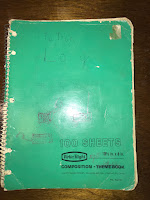
Original log book from
1971.
When I first got into radio, in 1971, I barely knew what I was doing. I had done some shortwave DXing with my GR-81, but that rig worked much better on the AM broadcast band than anywhere else. Just before labor day of 1971, I put up my first outdoor antenna. 

Previously, I had just used a spool of magnet wire strung around the ceiling of my attic bedroom. This was not a very good antenna. Just before school started in 1971, I bought a 25 foot roll of small speaker wire and unzipped it all. Soldering the two pieces together, this gave me 50 feet of antenna wire, which I strung out the window, across the garage and into a tree at the edge of the yard. 

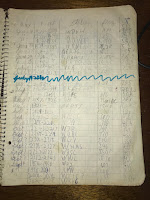
I was eager to try this new antenna, so I proceeded to tune across the AM broadcast band that evening, and log each station I could. I started about 9 PM, and kept tuning until midnight. The next evening, I continued the process. 

Sep 3 log page.
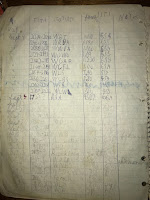
That first night, I had started at the bottom of the band at worked my way upwards. The second evening, I continued upwards, but then reversed and went lower in frequency. This made more sense to me, and my later "countdowns" that I would make in subsequent years all started at the top of the broadcast band and continued toward the bottom. 

Sep 4 log page.
This event inspired me that for the next several years, I would try to do a "countdown" around Labor Day weekend. It marked the end of the summer, but also the beginning of the radio season. 

I remember it distinctly. I would sit patiently and wait for the AM stations to ID, generally at the top or bottom of the hour. If I got lucky, they would ID sooner. 

Hard to believe that event was over fifty years ago. 


Wednesday, December 16, 2020

4U1UN (and 4U75UN)

A little more than a year ago, I was looking at the Most Wanted list in ClubLog. I noticed that the United Nations HQ entity was number 30 on the list. In all my years of ham radio, I had never heard them on the air, much less worked them. I wondered if I'd ever have the opportunity to work them at all.

Well, the 4U1UN club has been busy, and late fall 2019, they finished their installation which allows them to remotely operate a transceiver near the top of the UN towers from a room on the ground floor of the building. Since that time, they have been sporadically active. 

I don't know what the rules are for operating 4U1UN, but the station has been active at least some time every month during the past year. They have gone from an entity you'd wonder if you'd ever work, to one that can easily be worked by anyone with a bit of determination.

Over the past year, I've kept a running DX Watch query going to see when they were on the air, and worked them any time I could hear them. They've been easy to work even with compromise antennas.

They confused me in September, as I thought they had gone silent. No, they just switched callsigns. They are celebrating 75 years of the UN with the call 4U75UN. There's a special certificate for working them. They should continue with that call until December 31st.

They'd be pretty easy from the USA on 160m, but I don't believe anyone has ever operated on that band. I doubt they have an antenna, and I head the noise level in NYC is extraordinarily high.

They QSL promptly through LoTW (be patient, it may take a week or two to be uploaded). I've gone from wondering if I'd ever work them to having them confirmed on nine bands (80m-6m) and three modes: CW, Phone and Digital. 

Keep an eye peeled on the spotting networks, and perhaps you can work a new one.

Thursday, February 28, 2019

Back on the Tower Again

During my December vacation, I started a rather ambitious project on the tower. Since its installation, my A3S/A743 has been about eight inches from the very top of the mast. My intent was to put the beam at the very top of the mast, in order to give more room to stack an A50-3 under it.

It had been a while since I climbed on the tower, and any work at the very top is always nerve-wracking. As I've written before, sometimes you get up there and decide you've had enough.

Anyway, back to the December project. I conscripted my daughter Lauren to be my ground crew. I ascended the tower, removed the rotator and hung it from a couple of nylon loops off the side of the tower. Then I lowered the mast into the tower, until the A3S/A743 bracket was right at the top of the tower. The mast and antenna are somewhat heavy, weighing about 50 lbs. I relied on a pulley at the top and bottom of the tower and a haul rope to get support from my ground crew.

The tricky part of this operation was going to be moving the antenna higher on the mast. I had two options. First, I could loosen the bracket U-bolts, lift the antenna higher, then retighten. This would only take me about five hands, and I was only born with two. Second, I could loosen the bracket U-bolts, then lower the mast into the tower. While this seems easier, I had visions of the mast going too low and the antenna falling off the tower. Plus, I was afraid that we'd drop the mast and it would fall some 40-some feet into the base of the tower. And then the antenna would fall off the tower.

Plus, my daughter was having a lot of trouble getting sufficient leverage on my pull rope, which was 1/4". After being at the top of the tower a little over and hour, I decided to continue the project later.

Little did I know that it would take two months before I could get back up there!

In the intervening time, I had purchased 120 feet of 9/16" braided black poly rope. Our first order of business was to replace the existing 1/4" rope with this much more substantial lanyard. Once again with my trusty ground crew, we set out to complete the project.

With the bigger haul rope installed, I surveyed the top of the mast. I had thought that perhaps the antenna had slid down the mast in the 18 years it has been up. But a close examination of the mast showed no evidence of that. It had always been at that level.

Standing there 40-some odd feet in the air, 20 feet above the edge of my roof, I wondered if loosening the antenna would get me into a whole new world of problems. I decided at that moment I wasn't going to mount the A50-3 under the larger beam. What we needed to do was hoist the mast back and up and put the rotator back in place.

This proved to be a problem. Despite all her hauling away on the rope, Lauren was unable to raise the mast any significant distance. It was only with me grabbing the mast with two hands and pushing we were able to move it at all. I ended up locking down the mast with a couple of bolts in the tower and climbing down to solve the problem.

I had a ratcheting come-along, but hauling it up and using it on the tower was problematic. I ended up tying the come-along to a support pole, then hooking it into the haul rope via a tied loop. This would allow Lauren to use the come-along to provide lift, and I could manage things at the top of the tower.

After climbing back up, things moved a little more quickly. The come-along provided plenty of tension, but I found that I had to move the mast with my hands to get it to budge -- there's just too much friction and too much stretch in the poly rope. In a few minutes, we had the mast nearly back up into position. I had to re-position the pulley to get the last few inches to make room for the rotator.

With the mast locked down again, I hauled the rotator back into position. Thereupon I discovered two problems. First, one of the four nuts on the U-bolt that clamps the rotator to the mast was missing. In the two months on the tower, it apparently shook loose and fell off. Second, the rotator connection at the base of the rotator were loose -- one of the forked lugs had fallen off the wire and would need to be replaced.

Not having the necessary hardware at the top of the tower, I finished as much of the assembly as I could and came down the tower knowing that this project would be finished on another day. Hopefully, it won't take a couple of months to get back up there.


Friday, September 21, 2018

What's Next for DXCC?

At the end of summer every year, I start thinking about DXCC. For several years, it was getting more confirmations for 80m DXCC, so I could complete 5BDXCC. Last year, I accomplished that, including the 30m endorsement.

At the time of this writing, I have 109 confirmations for 17m. That band will be next - I'll submit that this year. This will also push me over the 1000 confirmations threshold for DXCC Challenge - I'll do that one at the same time.

The downside of earning DXCC awards on each band is there are fewer bands left.  On 12m, I need just 17 more confirmation. Given the low level of sunspot activity, that might take some doing. However, I did manage to add 10 confirmations since last year, so it is possible.

160m would be the next one. With 46/45 confirmations, it's further off. I'm not even half way to the necessary 100. I will definitely put some work into 160m this winter. But, honestly, DXCC on 160m may take a few years.

Speaking of years, on 6m I have a whopping seven confirmations. In the spring, I figured out how to use FT8 on this band, and while I heard a ton of DX, I only managed to work a handful. Definitely looking forward to the winter sporadic-E season. I think the most excitement I'll get for a while is finishing off 10-band confirmations. I have USA, Canada, Mexico, and Suriname on all 10 bands -- but there's several countries where I just need a 6m contact.

I've inched closer to Honor Roll, with 279/276 confirmed Mixed. have worked about nine of the remaining 64, but I need confirmations. Perhaps it is time to learn more about QSLing effectively.

And, if nothing else, it's fun building endorsements for the bands I already have. That's the fun of DXing -- it's long-term fun.


Friday, September 22, 2017

Life after 5BDXCC

For the last several years, I've started off the late summer thinking about my plans to complete 5BDXCC. This has meant figuring how who to make more DX contacts on 80m, whether that meant improving antennas or just being on the air more.

But, this June, I managed to wrangle enough confirmations to qualify. I'll likely submit these in November.

As that time of the season rolls around again, I have to think - what's next? What comes after 5BDXCC? It's a good question.

I still have a few other bands to add. On 17m, I have 87/87 confirmations, so that's likely next. It will be easier now that I've identified the problem with my WARC dipole. ON 12m, I have 73/73 confirmations is not that far behind, although old Sol is not likely to be active enough to sustain much propagation on that band for a few years.

160m seems less likely, where I have 42/41 confirmations. Given how hard 80m was, it may take quite a while to add many more entities there.

The DXCC challenge is still unclaimed. I have 835 current credits, and my unapplied LoTW confirmations will bring me up to 1125, if I applied them all. Plus at least five more QSLs I'll submit this year could get me all the way to 1130. I've decided a couple of years ago not to push for this too early. The 80m DXCC submission this year, plus all the band endorsements should get me over 950 credits. I'll make it over the 1000 credit requirement as soon as I complete another band.

And, of course, there's the DXCC Honor Roll. At the moment, I have 259 current confirmations, which puts be 80 away from the 339 total. And 71 away from the 330 required to make Honor Roll.  That may take quiet a while. I have two cards that I'll submit this year, and there's a dozen more entities I've worked that I need to obtain confirmations from.

Naturally, some of these remaining entities are increasingly rare. The good news is there are several exciting DXpeditions this year. I'll have to make plans to work them when I can.

So, yeah, still a lot of challenges left in DXCC.

Friday, June 16, 2017

5BDXCC - YES!

For the last four low-band seasons, I've been hoping I'd capture enough confirmations for 5BDXCC. I had already confirmed 40, 20, 15 and 10m DXCC, I just needed to get to the magic 100 entities on 80m. As I wrote in the fall, I just needed a few more to put me over the top.

At that time, I had 91/90 confirmed on LoTW, plus a couple of cards.

Today, I received a confirmation on 80m from CE2VMF, bringing my totals to 98/97 on LoTW. Plus, I have THREE cards with additional confirmations, which brings the overall total to 101/100.

I remember talking to Jim Streible K4DLI (who now, unfortunately, is a silent key) about his 5BDXCC plaque. Jim said he had spent 35 years earning that award. And Jim earned it back in the day before electronic confirmations, too.

So, when I apply for DXCC awards later this year, I'll be petitioning for 6BDXCC (got 30m, too!).

I'll have to seriously consider ordering the plaque.

Friday, March 31, 2017

Radio 2017 - Progress March

I don't want to admit it, but no, not a lot of progress on this. No long vacation excuses this time, just busy with life. What can I say?

I did get to review the WWDC videos regarding storyboards. I (re-)discovered a few interesting things:
  • Set the main storyboard in the info.plist - I had done this.
  • You can build up window content by using content segues to multiple view controllers. I didn't have a need for this yet, but I'm sure it's coming.
  • Control-Drag directly from a menu or button to a window content view. This will produce a segue to the view controller. Easy and useful. The host view controller receives a method call prepareForSegue:sender: before the window appears for the segue. I'm not using this because there doesn't seem to be a way to associate the document window for this action when it appears on the application menu. 
So, my main question became -- how does all the other document stuff work? When you select File / Save, how does that get to the NSPersistentDocument class? Turns out, it uses a basic target/action to the First Responder. 

I just had to figure out is how to add my action method for my modes window to the First Responder. That turns out to be easy. Select the First Responder icon of the main menu. Then, use the Attributes inspector, and you'll see a list of User-Defined actions. The weird thing is, though, once you've defined them, they disappear from this list.
No matter, just add an action, then edit it to be the method name you want. Then wire it up to the menu with control-drag as before. Implement the method anywhere in the responder chain. I implemented this in my document class. And my mode window comes up correctly, and I have a unique instance of it for each document. Cool.

Next is the hard part -- trying to figure out how to associate the managed object context of the document with the modes view controller. This is were it gets weird. The window controller has a property document which points to the document for that window. How you get to that value from the view controller is something I have not figured out yet. 

Tuesday, March 28, 2017

Cycle 25

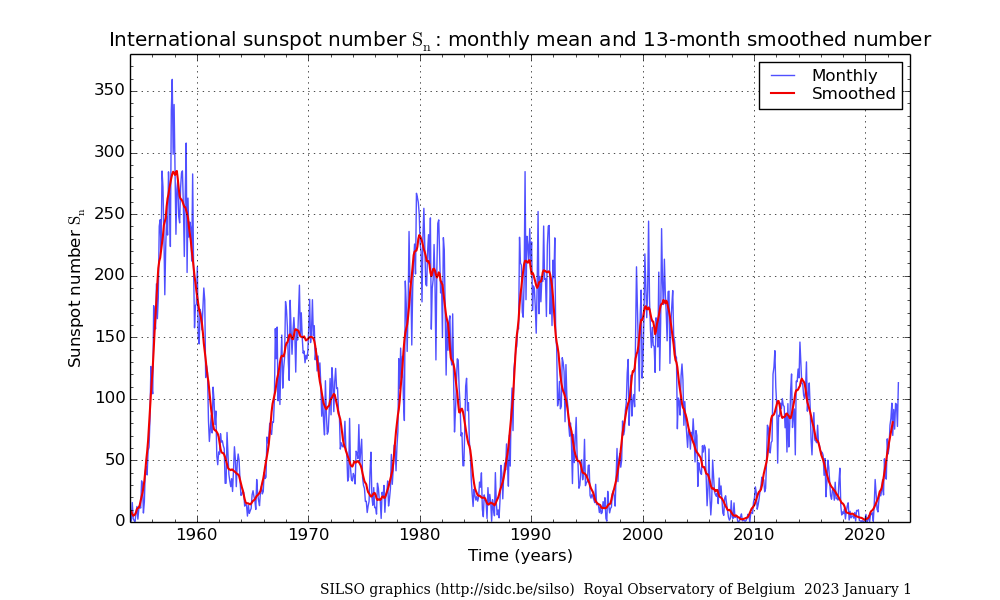
Smoothed SSN of the last six sunspot cycles.
Cycle 24 sucked.

I mean, really. Look at this graph. It's pretty clear that Cycle 24 was barely half as tall as the three cycles before it. It wasn't even as good as Cycle 20.

Smoothed SSN in Cycle 24 never made it over 82. The previous four cycles had several years over 100.

And that was after a sunspot low that lasted a couple of extra years before Cycle 24 began an upswing.

Now we're in that downward slide again. I know from experience that we're not seeing the end of the lull between cycles until the 2800 MHz solar flux gets down to 66 or 65. That's probably three years away. And then it will take a couple of years to build up. I'm thinking it will be about 2022 before Cycle 25 shows it's colors.

In the meantime, propagation on 160m and 80m should be pretty good in the winter months for the next several years.

I've told my wife, I want to be ready for Cycle 25. I want to have my antennas and station ready to rock when the sunspots come back.


Tuesday, February 28, 2017

Radio 2017 - Progress February

Well, I can't say that I've made much of any progress since the last posting. I took a 10-day trip to Israel to visit Bethlehem, Masada, Galilee, Jericho, Jerusalem -- all the holy sites. The trip was very intensive, and after I returned home it took me about a week to recover and then catch up on all my missed work.

I did spend a little time going over my test programs trying to figure out the right way to write Cocoa code for MacOS X document-based apps with Storyboards. What I'm doing seems too complicated.

So, I've decided I need to go back and find the WWDC videos regarding using storyboards with MacOS X, and it also might be useful to view the the ones for iOS docment-based apps as well, to see if that gives me any insight.

With any luck, I'll make much more progress in March.

Tuesday, January 31, 2017

Radio 2017 - Progress January

Quick progress report on the Radio 2017 project. I've managed to get started on the casual logging program. I've created the basic framework and a local Git repository. An early cut of the Core Data model is in place. You can't do much more than run the program and create, save and close documents so far.

I have discovered that Storyboards on MacOS don't quite seem ready for prime time. First, there's a bug that windows don't cascade when creating a new document. Second, the split of the original NSDocument class into NSViewController and NSPersistentDocument subclasses creates something of a conundrum. The NSPersistentDocument owns the Managed Object Context, but the NSViewController subclass is the place that owns all of the UI actions.

To make things worse, the main menus actions only appear to be able to effectively target the application delegate. If you want to target something in the NSViewController or NSDocument, you have to write a handler in the application delegate to find the current document view controller and call the right method.

I've figured out the proper way to do the menu actions, but I'm still puzzling out how to handle the managed object context from the view controller actions.

None of this is rocket science, but it's certainly slowed things down, as I have had to create separate projects in order to figure out the most appropriate way to do things.

I'm still learning Swift. The nuances of optionals and when to use the various operators is something that will come with practice. The compiler is keeping me on the straight and narrow.

Monday, December 26, 2016

The Radio 2017 Project

My long-time friend Chris, K4JCW, invented the term GUP. It's an acronym for Great, Unfinished Project. Naturally, any unfinished project can always be great. Because, well, it is unfinished. If it lacks greatness at the moment, there's always a chance it could be added. The greatness of any project reaches maximum before it starts.

A couple of months ago, I got to thinking about some of my unfinished software projects. I've already talked about my casual logging program. While I've made a few small enhancements over the years, it's basically the same program I wrote in 2006. There are others I've been meaning to write for the Mac for several years.

This summer, after the Apple World Wide Developers Conference (WWDC), I studied the updated Swift 3 language. It seemed to me that Swift was probably mature enough to start using. I also caught up on several videos, including those on how to use storyboards in MacOS applications, something that was certainly not possible ten years ago.

I decided it is time to develop some new Mac software. I've labeled this the Radio 2017 project, as I hope to be done within the year 2017. I have identified the need for the following applications:
  • Casual Logging Program - very basic logging program with import / export to ADIF, control of the Elecraft K2/K3, support for RTTY and PSK operating, as well as CW keying, automation via AppleEvents / Automator
  • Contest Logging Program - logging program with contests, supporting main ARRL, CQ and NA contests. Import / export to Cabrillo, ADIF. Support for CW keying and RTTY and PSK operating.
  • SDR Software to use with SoftRock Lite II - I purchased the SoftRock Lite II to use with the K3 IF frequency. This would serve as a pan adapter / spectrum analyzer.
  • Remote Control Server  and Client - to allow me to operate my Gwinnett station from anywhere.
  • QSL Tracking Software - track paper QSLs against awards.
All of these would be useful to me. There are probably a couple of utility applications to consider as well.

In writing this software, I've decided to stick to a few goals:

  • Swift 3 - the applications should be written almost entirely in Swift 3. (There are a few APIs -- notably Core Audio -- that are more appropriately accessed with Objective C/C++. I'll likely use Swift-callable wrapper classes for those)
  • Storyboards - the UI should be constructed using storyboards.
  • UI Guidelines - applications should follow the latest Mac UI guidelines.
  • Store-ready - should these applications turn out well, my stretch goal is to publish them on the Macintosh App store.
The hardest part of this sort of project is maintaining focus and motivation. I hope to help that by publishing my progress here each month. Wish me luck!

Monday, September 5, 2016

Pursuit of 5BDXCC IV - 80m


Shunt-feed wires rise up the side of the tower.
For the last three years, near the end of summer, I have written about converging on 5BDXCC. I wasn't close when I only had thirty countries to confirm on 80m. The next year, I had inched a little closer, but taking the proposition a bit more seriously. And last year,  I made some serious progress, and was hopeful I was within striking distance.

Let's review the numbers, shall we? Last year I stood at 89/88, right? Well, turns out, this was slightly off. I discovered that a confirmation of CP1FF on 15m Phone was credited to 80m. This has since been corrected, so I was really at 88/87.

Today, I hold 91/90. Yes! At least down to the last ten confirmations. Not a lot of progress from last year, but at least progress.

I do have paper QSL confirmations for a couple more entities on 80m. According to ClubLog, I've worked 103 countries on 80m. Looking at the data, perhaps a couple of those have busted calls on one end or the other.

This leaves me with two methods of achieving this goal: I can pursue getting paper confirmations from contacts I've already made, or I can strive to make more contacts and get LoTW confirmations from them.

Let's look at the latter.

Last year, I ran into a few obstacles trying to work DX on 80m. Since moving from Floyd County to Walton County, I had to take down the 80/40m dipole and also the very effective 160/80/40m Inverted-L. The 80/40m dipole is up at the Walton County QTH, but the low height and local noise limits its usefulness. With the Gwinnett County QTH just minutes away, I've been more tempted to operate from there, when I can. The 160/80/40m Inverted-L and all the 30 lbs of radials are still sitting in a box. I don't really have a location to put it up right now.

That leaves me with the shunt-feed tower for 80m. I ran into a number of issues last fall with the shunt-feed matching network. The 80m cap had to be replaced. I also found that the shunt isn't as effective as it might have been. Certain times of the early evening, the 80m dipole was much more effective.

Plus, I'm seeing some RFI-related issues when using the shunt-fed tower. These didn't affect the Elecraft K2/100 or the Kenwood TS-430S, but they sure make a mess of the Elecraft K3/100.

I also wanted to put up the K9AY loops with a new loop controller. The new loop controller didn't work properly, and even using the old mechanical switch, I discovered I had other RFI feedback from the K9AY loop feed line.

So, It's clear to me I need to take care of a number of things before fall begins:
  • Fix the Shunt-feed network. To improve matching on 80m, I'll add a relay and an extra variable capacitor, which would give me settings for 160m, 80m and 75m. I'll also bypass the control lines to prevent RFI ingress. Decoupling on the feed line couldn't hurt, either. 
  • Add Radials. The 29 or so radials for the shunt-fed tower may have deteriorated in the last 15 years, and a few of them have been damaged. I have about 2,000 feet of surplus cloth-covered copper wire, and my plan is to put it ALL down as radials. 
  • 80m Dipole. I'm working on a design for a trap 80/40/20m dipole, which may double as a second-radio antenna. That should go back up where the old 80/40m was.
  • Amplifier. One benefit of the 80m dipole is I can use the amplifier. The shunt-feed network can't handle much more than 100 watts. 
  • K9AY Loops. Fix the controller. Re-route the feed line to avoid RFI pick-up. 
Once all that is done, there's the small matter of being there. I guess I should start operating more from Walton County. Perhaps plan to work a few DX contests on 80m. Perhaps the ARRL DX contest would be good.

How about the former? I've already used ClubLog and OQRS to request paper QSLs for a couple of the contacts for which I have matching information. Those should come eventually.

Plus, I need to go through my batch of QSLs and see if I have anything matching on 80m. I think I did this exercise last year, but I've gotten some new QSLs from the bureau that I haven't processed yet.

The final step is to use ClubLog to identify some of those contacts I've worked and not confirmed and request paper QSLs. Those may take a while to arrive, but at least I don't have to fix antennas or wait for propagation to get that done.


Saturday, September 3, 2016

Uh-Oh.

There's that moment -- that moment of pure clarity. The pure clarity that occurs when you realize you've done something really stupid -- something stupid you can't take back.

This happened yesterday. You see, I got off work early and thought I'd spend the afternoon chasing a little DX. I managed to work VP6J on 12m CW, and later they moved down to 17m RTTY. I've never worked Pitcairn using RTTY, so I was watching their frequency closely. They weren't strong, but I went ahead and set up the amplifier on a clear nearby frequency. The day was waning, and I figured if they ever came up a bit so I could get clear print, I'd want to give it my best shot.

In the meantime, I moved down to 30m and worked some other stations. Of course, I switched the AL-80A to standby, and cranked up to 100 watts.

Everything was fine. Until later I went back to 17m to see how VP6J was doing. Their signal had come up a bit, and I could actually read the print well enough to try for a contact. I reached over and flipped the amplifier to operate, and clicked the button to send my call.

That's when I had my moment of clarity.

There was a loud noise from the RF compartment of the AL-80A, along with several sparks, and abruptly, it went dark. An acrid burning smell hung loosely in the air. Certainly, something had gone wrong.

I knew right away what I had done. I had transmitted 100 watts into an amplifier designed to take only 50 watts input.. An amplifier whose original design had not included 17m, and was happier with 40 watts on that band.

Roasted plate choke in AL-80A.
I switched the amp off and then back on, still dark. Clearly, I've blown a fuse. A quick check verified that one of the two 10A fuses had blown. It was replaced, and the amp came back to life. But as it turned on, there was a tiny arc coming from the plate choke. I switched it back off, turned the meter to the HV setting, and briefly switched it on again. The High Voltage looked fine, but I was going to have to get the amp on the workbench to see what was wrong with the choke.

Once I got the cover off, it was easy to see the problem. The plate choke has a black burnt mark. Looking closer, the turns of the choke had melted and separated. The choke would need to be replaced. From the location of the burn, it looks like it had arced from the end of a screw on the plate tuning capacitor to the choke.

I took the tube out and gave it a quick check with an ohmmeter. No grid to cathode or grid to plate shorts, which was good. The Taylor 3-500Z is pretty darn tough, and likely shrugged off the abuse I had just put it through.

Low voltage cap blown to protect meter.
While I had the amp on the bench, I checked out a couple of other things. Looks like one of the protective caps I placed on the B- rail to ground failed. Probably helped to protect the meter movements.

I'll be replacing that cap, along with the 1N4007 rectifier, since it must have gone open for the capacitor to fail. I'll replace it with the recommend 1N5408 rectifier, which can handle a whole lot more surge current.

Melted switch contacts.
Another mystery of this AL-80A I solved -- why it wouldn't tune up on 160m. An inspection of the front switch wafer shows that the switch contacts for the additional plate tuning cap have completely melted away. Since I've never used the amp on 160m, this was not me -- this was an existing problem. The switch contacts, or perhaps the wafer will need to be replaced to restore service on that band.

I ordered a replacement plate choke from Ameritron. They don't carry the original AL-80A part, but instead use a single choke (Part number 10-15197) for virtually all their amplifiers, including the more modern AL-80B. I've read this part avoids resonances on 17m which may be present in the original single-winding choke.

In the meantime, I'll have to chase DX without an amplifier for a while. Perhaps there won't be as many fireworks.

Update: I've been told that part of the problem with the 160m switch contacts is the lack of a corona washer. The picture clearly shows an absence of this part. I'll be adding one when I make the repair.