Showing posts with label ARRL. Show all posts

Friday, June 28, 2024

The Great LoTW Outage - Continues.

Update July 1, 2024. LoTW is back up! It is running slow, but it is available. Thank goodness.

--

When I wrote the article back in May, I hardly thought that LoTW would be down a month later.

Sadly, the outage continues. 

My suspicions were correct, however, that this was something more than a simple networking problem. The ARRL has since admitted their network was viciously and uniquely hacked. I can certainly understand their caution to make sure that every system linked to LoTW is given a clean bill of health before turning the system back on.

Earlier this week, on Tuesday there was apparently a brief period of time when LoTW was accessible. A couple of my ham buddies managed to upload some contacts. They'll have to wait for confirmations when the rest of us can get in.

I do hope it is soon. I'm really missing this service.

Monday, May 27, 2024

The Great LoTW Outage

May 16th, there was an issue with Logbook of The World (LoTW). I could not load the main page at all -- receiving an error indicating the server wasn't responding.

That's pretty normal stuff, actually. There are dozens of problems that can result in this kind of error, so I wasn't surprised. I figured the ARRL staff would address it quickly. But, after much of the day, I was still getting the error. 

So, I sent a message to lotw-help@arrl.org, informing them that the web site wasn't responding, kindly asking when they expected it to be back up. I mentioned I was surprised there was no notice of the outage on the ARRL.org web site.

Later that day, the ARRL put up a notice that there was a service disruption involving access to the network, and that it affected LoTW and the ARRL Learning Center. They even updated it the next day, addressing concerns users had over information privacy.

But then, nothing happened. Not until May 22nd, when they updated the notice without really adding any information. 

Now, part of this delay may be due to the fact that much of the ARRL staff were all out at the Xenia Hamvention. But, that was a week ago.

What gives? Sure, networking problems. Honestly, though, as a computer professional, networking problems generally don't take more than a week to solve. I'm beginning to suspect there's something more than the ARRL hasn't told us, but I can't be sure.

I'm really missing access to LoTW. In the last 20 years, it has really become central in my enjoyment of the hobby. I do hope I'm wrong, and that ARRL manages to fix this problem soon.

Monday, February 6, 2023

Nine-Band Worked All States

Nearly twelve years ago, I wrote about completing Worked All States on six bands. I'd worked all states on 160, 80, 40, 20, 15 and 10m. About three years ago, I finished up 30m, so now it was seven bands. However, finishing 17 and 12m seemed like it would take forever. I felt stalled out.

A couple of months ago, it occurred to me that I was only four band-states away from Ten-Band Worked All States. I needed Delaware on 17m, Kentucky on 12m, and Alaska and Hawaii on 6m. 

The 6m states would have to wait -- I'd need very special conditions to work either state. But with the recent rise in sunspots, working those close-in states on 17 and 12m seemed do-able. The biggest problem would be operating the Gwinnett station. That was solved after I configured the RemoteRig devices to allow remote operation

Indeed, the first afternoon operating remotely, I was able to work Kentucky on 12m and the LoTW confirmation came the next day. Finishing off 17m took a month longer.

It was surprising to me how calling CQ DEL AA4LR EM83 would gather so many responses from people who were not in Delaware. I worked at least one station in Delaware, but the LoTW confirmation was not forthcoming. Then the RemoteRig Control device no longer powered up.

I got lucky one Friday afternoon when I was in Gwinnett county and managed to get a legitimate answer to my CQ DEL message and a confirmation later that day. I'd done it. Worked All States on Nine Bands. 

Now, I just have to wait for those special conditions in order to work Alaska and Hawaii on 6m....

Friday, September 21, 2018

What's Next for DXCC?

At the end of summer every year, I start thinking about DXCC. For several years, it was getting more confirmations for 80m DXCC, so I could complete 5BDXCC. Last year, I accomplished that, including the 30m endorsement.

At the time of this writing, I have 109 confirmations for 17m. That band will be next - I'll submit that this year. This will also push me over the 1000 confirmations threshold for DXCC Challenge - I'll do that one at the same time.

The downside of earning DXCC awards on each band is there are fewer bands left.  On 12m, I need just 17 more confirmation. Given the low level of sunspot activity, that might take some doing. However, I did manage to add 10 confirmations since last year, so it is possible.

160m would be the next one. With 46/45 confirmations, it's further off. I'm not even half way to the necessary 100. I will definitely put some work into 160m this winter. But, honestly, DXCC on 160m may take a few years.

Speaking of years, on 6m I have a whopping seven confirmations. In the spring, I figured out how to use FT8 on this band, and while I heard a ton of DX, I only managed to work a handful. Definitely looking forward to the winter sporadic-E season. I think the most excitement I'll get for a while is finishing off 10-band confirmations. I have USA, Canada, Mexico, and Suriname on all 10 bands -- but there's several countries where I just need a 6m contact.

I've inched closer to Honor Roll, with 279/276 confirmed Mixed. have worked about nine of the remaining 64, but I need confirmations. Perhaps it is time to learn more about QSLing effectively.

And, if nothing else, it's fun building endorsements for the bands I already have. That's the fun of DXing -- it's long-term fun.


Friday, September 22, 2017

Life after 5BDXCC

For the last several years, I've started off the late summer thinking about my plans to complete 5BDXCC. This has meant figuring how who to make more DX contacts on 80m, whether that meant improving antennas or just being on the air more.

But, this June, I managed to wrangle enough confirmations to qualify. I'll likely submit these in November.

As that time of the season rolls around again, I have to think - what's next? What comes after 5BDXCC? It's a good question.

I still have a few other bands to add. On 17m, I have 87/87 confirmations, so that's likely next. It will be easier now that I've identified the problem with my WARC dipole. ON 12m, I have 73/73 confirmations is not that far behind, although old Sol is not likely to be active enough to sustain much propagation on that band for a few years.

160m seems less likely, where I have 42/41 confirmations. Given how hard 80m was, it may take quite a while to add many more entities there.

The DXCC challenge is still unclaimed. I have 835 current credits, and my unapplied LoTW confirmations will bring me up to 1125, if I applied them all. Plus at least five more QSLs I'll submit this year could get me all the way to 1130. I've decided a couple of years ago not to push for this too early. The 80m DXCC submission this year, plus all the band endorsements should get me over 950 credits. I'll make it over the 1000 credit requirement as soon as I complete another band.

And, of course, there's the DXCC Honor Roll. At the moment, I have 259 current confirmations, which puts be 80 away from the 339 total. And 71 away from the 330 required to make Honor Roll.  That may take quiet a while. I have two cards that I'll submit this year, and there's a dozen more entities I've worked that I need to obtain confirmations from.

Naturally, some of these remaining entities are increasingly rare. The good news is there are several exciting DXpeditions this year. I'll have to make plans to work them when I can.

So, yeah, still a lot of challenges left in DXCC.

Friday, June 16, 2017

5BDXCC - YES!

For the last four low-band seasons, I've been hoping I'd capture enough confirmations for 5BDXCC. I had already confirmed 40, 20, 15 and 10m DXCC, I just needed to get to the magic 100 entities on 80m. As I wrote in the fall, I just needed a few more to put me over the top.

At that time, I had 91/90 confirmed on LoTW, plus a couple of cards.

Today, I received a confirmation on 80m from CE2VMF, bringing my totals to 98/97 on LoTW. Plus, I have THREE cards with additional confirmations, which brings the overall total to 101/100.

I remember talking to Jim Streible K4DLI (who now, unfortunately, is a silent key) about his 5BDXCC plaque. Jim said he had spent 35 years earning that award. And Jim earned it back in the day before electronic confirmations, too.

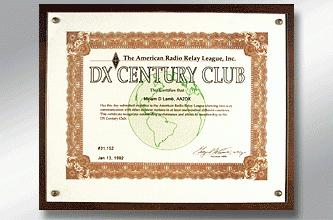
So, when I apply for DXCC awards later this year, I'll be petitioning for 6BDXCC (got 30m, too!).

I'll have to seriously consider ordering the plaque.

Friday, March 31, 2017

Radio 2017 - Progress March

I don't want to admit it, but no, not a lot of progress on this. No long vacation excuses this time, just busy with life. What can I say?

I did get to review the WWDC videos regarding storyboards. I (re-)discovered a few interesting things:
  • Set the main storyboard in the info.plist - I had done this.
  • You can build up window content by using content segues to multiple view controllers. I didn't have a need for this yet, but I'm sure it's coming.
  • Control-Drag directly from a menu or button to a window content view. This will produce a segue to the view controller. Easy and useful. The host view controller receives a method call prepareForSegue:sender: before the window appears for the segue. I'm not using this because there doesn't seem to be a way to associate the document window for this action when it appears on the application menu. 
So, my main question became -- how does all the other document stuff work? When you select File / Save, how does that get to the NSPersistentDocument class? Turns out, it uses a basic target/action to the First Responder. 

I just had to figure out is how to add my action method for my modes window to the First Responder. That turns out to be easy. Select the First Responder icon of the main menu. Then, use the Attributes inspector, and you'll see a list of User-Defined actions. The weird thing is, though, once you've defined them, they disappear from this list.
No matter, just add an action, then edit it to be the method name you want. Then wire it up to the menu with control-drag as before. Implement the method anywhere in the responder chain. I implemented this in my document class. And my mode window comes up correctly, and I have a unique instance of it for each document. Cool.

Next is the hard part -- trying to figure out how to associate the managed object context of the document with the modes view controller. This is were it gets weird. The window controller has a property document which points to the document for that window. How you get to that value from the view controller is something I have not figured out yet. 

Tuesday, February 28, 2017

Radio 2017 - Progress February

Well, I can't say that I've made much of any progress since the last posting. I took a 10-day trip to Israel to visit Bethlehem, Masada, Galilee, Jericho, Jerusalem -- all the holy sites. The trip was very intensive, and after I returned home it took me about a week to recover and then catch up on all my missed work.

I did spend a little time going over my test programs trying to figure out the right way to write Cocoa code for MacOS X document-based apps with Storyboards. What I'm doing seems too complicated.

So, I've decided I need to go back and find the WWDC videos regarding using storyboards with MacOS X, and it also might be useful to view the the ones for iOS docment-based apps as well, to see if that gives me any insight.

With any luck, I'll make much more progress in March.

Tuesday, January 31, 2017

Radio 2017 - Progress January

Quick progress report on the Radio 2017 project. I've managed to get started on the casual logging program. I've created the basic framework and a local Git repository. An early cut of the Core Data model is in place. You can't do much more than run the program and create, save and close documents so far.

I have discovered that Storyboards on MacOS don't quite seem ready for prime time. First, there's a bug that windows don't cascade when creating a new document. Second, the split of the original NSDocument class into NSViewController and NSPersistentDocument subclasses creates something of a conundrum. The NSPersistentDocument owns the Managed Object Context, but the NSViewController subclass is the place that owns all of the UI actions.

To make things worse, the main menus actions only appear to be able to effectively target the application delegate. If you want to target something in the NSViewController or NSDocument, you have to write a handler in the application delegate to find the current document view controller and call the right method.

I've figured out the proper way to do the menu actions, but I'm still puzzling out how to handle the managed object context from the view controller actions.

None of this is rocket science, but it's certainly slowed things down, as I have had to create separate projects in order to figure out the most appropriate way to do things.

I'm still learning Swift. The nuances of optionals and when to use the various operators is something that will come with practice. The compiler is keeping me on the straight and narrow.

Monday, January 23, 2017

5BDXCC? - Well, Not Really.

Back in December, I made my annual submission to the DXCC desk. In addition to adding a few endorsement entities to my DXCC Mixed, CW, Phone, Digital, 40m, 20m, 15m and 10m, I also submitted enough credits for DXCC 30m as well.

Let's see, thats 40m, 30m, 20m, 15m, and 10m. That's five bands! 5BDXCC, right?

No, not really. 5BDXCC requires DXCC on 80m, which I haven't accomplished yet. Getting there.

Monday, December 26, 2016

The Radio 2017 Project

My long-time friend Chris, K4JCW, invented the term GUP. It's an acronym for Great, Unfinished Project. Naturally, any unfinished project can always be great. Because, well, it is unfinished. If it lacks greatness at the moment, there's always a chance it could be added. The greatness of any project reaches maximum before it starts.

A couple of months ago, I got to thinking about some of my unfinished software projects. I've already talked about my casual logging program. While I've made a few small enhancements over the years, it's basically the same program I wrote in 2006. There are others I've been meaning to write for the Mac for several years.

This summer, after the Apple World Wide Developers Conference (WWDC), I studied the updated Swift 3 language. It seemed to me that Swift was probably mature enough to start using. I also caught up on several videos, including those on how to use storyboards in MacOS applications, something that was certainly not possible ten years ago.

I decided it is time to develop some new Mac software. I've labeled this the Radio 2017 project, as I hope to be done within the year 2017. I have identified the need for the following applications:
  • Casual Logging Program - very basic logging program with import / export to ADIF, control of the Elecraft K2/K3, support for RTTY and PSK operating, as well as CW keying, automation via AppleEvents / Automator
  • Contest Logging Program - logging program with contests, supporting main ARRL, CQ and NA contests. Import / export to Cabrillo, ADIF. Support for CW keying and RTTY and PSK operating.
  • SDR Software to use with SoftRock Lite II - I purchased the SoftRock Lite II to use with the K3 IF frequency. This would serve as a pan adapter / spectrum analyzer.
  • Remote Control Server  and Client - to allow me to operate my Gwinnett station from anywhere.
  • QSL Tracking Software - track paper QSLs against awards.
All of these would be useful to me. There are probably a couple of utility applications to consider as well.

In writing this software, I've decided to stick to a few goals:

  • Swift 3 - the applications should be written almost entirely in Swift 3. (There are a few APIs -- notably Core Audio -- that are more appropriately accessed with Objective C/C++. I'll likely use Swift-callable wrapper classes for those)
  • Storyboards - the UI should be constructed using storyboards.
  • UI Guidelines - applications should follow the latest Mac UI guidelines.
  • Store-ready - should these applications turn out well, my stretch goal is to publish them on the Macintosh App store.
The hardest part of this sort of project is maintaining focus and motivation. I hope to help that by publishing my progress here each month. Wish me luck!

Monday, September 5, 2016

Pursuit of 5BDXCC IV - 80m


Shunt-feed wires rise up the side of the tower.
For the last three years, near the end of summer, I have written about converging on 5BDXCC. I wasn't close when I only had thirty countries to confirm on 80m. The next year, I had inched a little closer, but taking the proposition a bit more seriously. And last year,  I made some serious progress, and was hopeful I was within striking distance.

Let's review the numbers, shall we? Last year I stood at 89/88, right? Well, turns out, this was slightly off. I discovered that a confirmation of CP1FF on 15m Phone was credited to 80m. This has since been corrected, so I was really at 88/87.

Today, I hold 91/90. Yes! At least down to the last ten confirmations. Not a lot of progress from last year, but at least progress.

I do have paper QSL confirmations for a couple more entities on 80m. According to ClubLog, I've worked 103 countries on 80m. Looking at the data, perhaps a couple of those have busted calls on one end or the other.

This leaves me with two methods of achieving this goal: I can pursue getting paper confirmations from contacts I've already made, or I can strive to make more contacts and get LoTW confirmations from them.

Let's look at the latter.

Last year, I ran into a few obstacles trying to work DX on 80m. Since moving from Floyd County to Walton County, I had to take down the 80/40m dipole and also the very effective 160/80/40m Inverted-L. The 80/40m dipole is up at the Walton County QTH, but the low height and local noise limits its usefulness. With the Gwinnett County QTH just minutes away, I've been more tempted to operate from there, when I can. The 160/80/40m Inverted-L and all the 30 lbs of radials are still sitting in a box. I don't really have a location to put it up right now.

That leaves me with the shunt-feed tower for 80m. I ran into a number of issues last fall with the shunt-feed matching network. The 80m cap had to be replaced. I also found that the shunt isn't as effective as it might have been. Certain times of the early evening, the 80m dipole was much more effective.

Plus, I'm seeing some RFI-related issues when using the shunt-fed tower. These didn't affect the Elecraft K2/100 or the Kenwood TS-430S, but they sure make a mess of the Elecraft K3/100.

I also wanted to put up the K9AY loops with a new loop controller. The new loop controller didn't work properly, and even using the old mechanical switch, I discovered I had other RFI feedback from the K9AY loop feed line.

So, It's clear to me I need to take care of a number of things before fall begins:
  • Fix the Shunt-feed network. To improve matching on 80m, I'll add a relay and an extra variable capacitor, which would give me settings for 160m, 80m and 75m. I'll also bypass the control lines to prevent RFI ingress. Decoupling on the feed line couldn't hurt, either. 
  • Add Radials. The 29 or so radials for the shunt-fed tower may have deteriorated in the last 15 years, and a few of them have been damaged. I have about 2,000 feet of surplus cloth-covered copper wire, and my plan is to put it ALL down as radials. 
  • 80m Dipole. I'm working on a design for a trap 80/40/20m dipole, which may double as a second-radio antenna. That should go back up where the old 80/40m was.
  • Amplifier. One benefit of the 80m dipole is I can use the amplifier. The shunt-feed network can't handle much more than 100 watts. 
  • K9AY Loops. Fix the controller. Re-route the feed line to avoid RFI pick-up. 
Once all that is done, there's the small matter of being there. I guess I should start operating more from Walton County. Perhaps plan to work a few DX contests on 80m. Perhaps the ARRL DX contest would be good.

How about the former? I've already used ClubLog and OQRS to request paper QSLs for a couple of the contacts for which I have matching information. Those should come eventually.

Plus, I need to go through my batch of QSLs and see if I have anything matching on 80m. I think I did this exercise last year, but I've gotten some new QSLs from the bureau that I haven't processed yet.

The final step is to use ClubLog to identify some of those contacts I've worked and not confirmed and request paper QSLs. Those may take a while to arrive, but at least I don't have to fix antennas or wait for propagation to get that done.


Monday, April 18, 2016

DXCC - Meeting the Challenge

Since I started uploading my logs to the ARRL Logbook of the World in November 2003, I've been working toward the DXCC Challenge. I've been carefully trying to work DX stations on multiple bands, hoping to get my current entity-band totals past the Challenge threshold of 1000.

Well, sometime this weekend, I received enough confirmations to get me past the 1000 mark. At the moment, I have 1003 entity-bands confirmed.

I guess I'll be submitting an application for the DXCC Challenge this year! That along with 30m DXCC.

UPDATE: I also notice that I have exactly 239 current entities confirmed for Mixed DXCC. This means I'm exactly 100 entities away from working all 339 current entities, or 91 away from the DXCC Honor Roll.


Saturday, April 2, 2016

DXCC - Excellent Service!

CP1FF QSL clearly shows 15m Phone.
I recently uploaded all my logbooks to ClubLog, and I was trying to reconcile my DXCC credits with those shown in LoTW. While doing this, I noticed something odd.

Back in 2009, I submitted a hybrid application for Phone DXCC using, 52 LoTW credits, and 10 paper QSLs. Among the paper QSLs was one for an SSB contact with CP1FF on 21 MHz.

I received credit for Bolivia for my SSB contact, so I didn't think much of it. However, in trying to reconcile with ClubLog, I noticed that the credit was apparently entered for 80m instead of 15m.

I've never worked CP1FF on 80m. Indeed, I have never worked Bolivia on 80m at all. Why did I have credit for it?

A quick email to the DXCC Admin sorted this out right away. She changed my credit from 80m to 15m, as it should be. Thank you!

Of course, this means I'm one more entity further away from 80m DXCC....

Thursday, October 15, 2015

The Last One Hundred (Plus Nine)

Back in 2007, after uploading logs to Logbook of the World for three and a half years, I qualified for DXCC. I'd been licensed as a ham 32 years earlier, and had worked nearly 200 entities, but didn't get the confirmations until 2007.

I mentioned this on the SEDXC email-reflector, and got many positive replies. David Johnson K4SSU wrote me and said that he envied the enjoyment I would have working and confirming the next 200+ entities.

Now, eight years later, I have been at 231 current entities for a few months now. It dawned on me that I have only 100 more to go to reach the honor roll. I'm now working up that steeper slope that David Johnson mentioned, where the thrill of working a new one comes only after much waiting.

I haven't been idle. I'm inching closer to 5BDXCC, and trying to work the DXpeditions as they pop up -- especially those that aren't on the air but once a decade.

Still, there's a lot of DX, even easy DX that has eluded me. I still haven't gotten the hang of postal QSLs -- still depending far too much on LoTW. That's probably something I need to fix. There's probably a bunch of DX I've already worked that can't be confirmed any other way.


Monday, August 31, 2015

Pursuit of 5BDXCC III - 80m

I wrote of this dream first two years ago. Back then, I thought it would be an easy thing, perhaps to work (and confirm) nearly 30 countries on 80m in a single winter. Boy, was I naive. I only added six confirmations on 80m the entire year.
Can this shunt-fed tower put me over the top?
The next  year, I at least had the sense to understand the difficulty of the proposition. I enumerated things I might do that year. In the end, I only did a couple of them. I did not add more radials to the Inverted-L, I did not bring the amplifier up to Floyd county, I never did finish the new K9AY controller. 

However, I was there a lot. I spent a lot of time on 80m. As a result, I now stand at 89/88 confirmations - I added a dozen over the year. That's twice as productive as the previous year. 

If I can pull it off again this year with a dozen confirmations, I should be able to meet all the requirements of 5BDXCC.

It's going to be interesting. At the moment, the Inverted L, with over 30 lbs of radials, is sitting in a box. I'm still trying to figure out if I can put it somewhere where I can lay down those radials safely. My only 80m DX antenna is the shunt-fed tower in Gwinnett county. 

Wish me luck.


Monday, February 16, 2015

K1N - Fabulous DXpedition

My Results from K1N
Well, it's over now. The much-anticipated K1N DXpedition to Navassa Island is now over. Lucky for me, I made it into the log multiple times, which makes me quite pleased.

Granted, it was a pretty easy shot from here in northwest Georgia to Navassa Is compared to other parts of the world. They were quite strong on just about every band, with the exception of 10 and 12m. I never heard a peep from them on 6m.

The pileups in the low bands were completely crazy in the evenings. All of my contacts 30m and below were made in either the 0900z or 1000z hour -- 4 or 5 AM local. That's one of the secrets of working DX -- be on the band when others are not! The one exception was 60m, and, honestly, the channel was so crazy I'm not entirely sure how I made it into the log.

All of these contacts were made with 100 watts and wire antennas, either the Inverted-L or the 80/40m dipole. Working DX does not require huge amplifiers and large antennas.

The team on Navassa Island did a fantastic job handing out contacts despite unruly pileups, deliberate QRM and the usual craziness. I witnessed on CW pileups that extended over 30 kHz with people continuously calling. Finding the listening frequency in the second receiver was an incredibly difficult task, and quite often I was just guessing -- but a few times I got lucky.

As I told my friend Mike, W1YM, now that I have Navassa Is on nine bands, I'm planning to volunteer to operate the next time team heads to the island. Perhaps in 10 years....

Wednesday, February 4, 2015

K1N - in the Log!

From the Department of "OK, that was a little bit weird":

Just after the SuperBowl, I easily found spots for K1N on 40m - they had just started operating. He was quite loud on the Inverted-L. At that point, the challenge wasn't in finding the DX, but finding exactly where he was listening.

As a belated Christmas present for myself, I bought the KRX3 -- the second receiver option for the K3. After ten months of chasing all the W1AW-portable stations, I became pretty proficient at pressing the REV button and tuning around to find the split listening frequency. Months I spent thinking that this would all be so much easier if I could just hear both sides at the same time.

Adapting to the second receiver wasn't so easy. While I've had a little practice with two radio operation, it isn't easy concentrating on one signal in one ear, and perhaps a bunch of signals in the other. I've had a little time to practice with it, and while it is really handy, I find that sometimes its easier to just listen to one receiver at a time.

In any case, the bedlam I found surrounding K1N was a LIDfest in the extreme. K1N was clearly asking for European stations only, and yet there were thousands of K, W and AA-AL stations calling madly. More than 15 kHz of the 40m band was covered in signals repeatedly sending their calls. It was going to be very difficult to discover the DX stations listening frequency. Add to this mess the number of operators who could not figure out how to properly configure their rigs for split operation. Plus the frequency cops repeatedly sending "UP UP", clearly interfering with the K1N transmissions.

Please, guys. I have written about how to work DX before. You have to LISTEN. Stop transmitting, and listen.

After about 40 minutes of that mess, I turned the rig off. I'd work them later. I hoped. Well, I'd have nearly two weeks of chances.

The next morning, I woke a little early at about 4:30 AM. I felt rested, so I figured I'd go out to the shack and check on K1N.

I half expected to hear K1N on at least 40 and 80m. I had heard them briefly the evening before on 80m, only to hear the operator send VERY TIRED QRX 5 HOURS. Great. (Well, I'm sure those guys were exhausted from the trip and all the setup)

Nothing to be found on 80m, but K1N was hoppin' on 40m. And seems like most of the lids had gone to bed. About five minutes later, I figure out roughly where he's listening (only about 9 kHz of people calling this morning), and it's time to join the fray.

Wait. He's gone. For about five minutes, there's no transmissions from K1N. Then a series of Vs, and he's back - works a couple of Qs, then disappears. Hmm. I keep calling for a while. I figure the generator may have quit, or someone tripped over a cable or something. Might as well call as I'm listening.

That's when something weird happened. You see, I'm using that KRX3 module, listening to the K1N transmit frequency in my left ear, and my own transmit frequency in my right ear. Then, very clearly, I hear "AA4LR 5NN" -- in my right ear. My transmitting frequency. OK, that's not right. I figure it's just some lid out there that's heard me calling over and over, and is just messing with me. Or maybe I'm just sleepier than I thought. I glance up and confirm, visually, that I am indeed operating split. Yes, thank God I'm not a lid -- today.

But, he comes again "AA4LR 5NN" -- insistently. Speed, cadence and strength are about right -- but it is definitely in my right ear. Well, why the heck not: "R 5NN TU" and the reply comes "TU UP" -- again in my right ear. But nothing else.

Right about that moment, the operator must have realized something was amiss. Next transmission is in my left ear - "K1N UP". For a moment, I'm flabbergasted. Did I work him, or not? Well, if I did, I know exactly where he's listening - so I send my call exactly once. "AA4LR 5NN", "R 5NN TU", "TU UP".

There. In the space of 20 seconds -- less time than it takes to read about it, I'd worked K1N twice -- once simplex, once split. Once in one ear, once in both.

About an hour later, I find there's spots on 80m. He's very strong, but even stronger on the trap dipole. The pileup is fresh, and hasn't had time to get as unruly as 40m. In three minutes, I found where he's listening and he comes right back to me.

UPDATE: Looks like he logged me twice as well, as I have two 40m CW contacts in ClubLog. Fine operator!

Wednesday, December 31, 2014

W1AW-Portable - Thanks for a fun year!

Well, it's over now. All the W1AW-portable operations are complete. It's been a great, great year. I have had a ton of fun chasing these stations. I only wish I had gotten started in the first couple of months, rather than just the last 10.

According to my log, I've worked W1AW-portable stations 1276 times. It's been a lot of fun. I'm definitely going to miss this in the new year.

ARRL 160m 2014

Two radio setup for the ARRL 160m contest.
K3 on right, K2 on left.
For the 2013 running of the ARRL 160m, I put in more operating hours than ever before, but I fell short of my personal best set in 2010. For 2014, I wanted to make sure that I set a new record.

Two radios would allow me to call CQ while I am scanning the band for other stations. I had used two radios in 2013, but it proved to be ineffective.

The inverted-L is my only 160m antenna. That would go to the K3. What I needed was some type of receiving antenna for the K2. The 80/40m dipole wouldn't cut it, as I found in 2013.

I had intended to set up some K9AY loops, and I've been working on a push-button controller for it. That project ran into a snag at the last minute, so some creativity was in order. I ended up stringing a 150 foot "Beverage" antenna into the woods. At such a short length and unterminated, it's not a true Beverage, but it did allow me to receive with the K2.

The two-radio setup was configured in haste about an hour before the contest. While the K3 continued to overload the K2 even with the receiving antenna, I used the K2 to populate the band-map while CQing. This did not produce a significant change in the number of Qs, but it did allow me to listen to other parts of the band during the slowest periods.

Started the contest at 2201z and continued all night to 1230z, right at sunrise. The all-night shift was tough, but netted 544 Qs and 68 multipliers. Conditions seemed good but not great. Worked 47 states - all but AK, HI and MT. Early part of the contest was nearly all CQing, with short sessions of S & P to look for mults, as well as when rates got slow after 0600z.

Second night started at 2210z until 0456z. It might have been better to stay on until 0600z, but I was exhausted. Got back on at 1040z, and switched off at 1240z. That's over 23 hours of contest time. There are only 28 hours of darkness in this part of the world at this time of year, and I was on the air for 22 of them.

Passed 700 Qs around 0430z the second night -- which put me into personal record territory. What I needed was mults. In my previous best, I had 78 mults. However, there was no DX to be found. I heard no Europeans, and very little from the Caribbean. Worked XE, PJ2 and ZF. Heard a V3, but he did not hear my calls.

Very hard the second night to decide between calling CQ and S & P. I ended up mostly S & P, because the rate was slightly better.

Found missing mults the second night, with MT, LAX, SCV, SV, MAR and WTX. With three countries that makes 74. Total 745 QSOs for a total score of 111,148.

I really feel like I am pushing the limits of what can be done with 100 watts and 1500 feet of wire suspended from trees. Score might be a little higher if I had stayed up the second night.

This contest is always a blast. See you next year.