Showing posts with label History. Show all posts

Monday, September 30, 2024

Cycle 25 is Kicking Butt

Don't know why I didn't write about this when it happened.

August 9th, the daily Sunspot Number (SSN) was 382. That seemed enormously high. I couldn't remember a single time when the SSN was that high. So, I did some digging.

I downloaded all the SSN data, converted into an Excel spreadsheet and did some analysis. The SSN hasn't been that high since 1991. That's 33 years ago!

The SSN has only been this high a total of ten times in my lifetime (since February 1961) -- Five in 1979, Twice in 1989, and Three times in 1991. 

Of course, none of this compares with Cycle 19, where daily SSN values were well over 500 for many days. But those values all happened 1956-1959, well before I was born.

Cycle 25 is shaping up to be much better than Cycle 24, which was really lousy, and possibly better than Cycle 23.  The smoothed SSN has already exceeded the maximum value for Cycle 24, and it is far from over. 

We've already seen a huge change in the bands in the last couple of years. 20m is open 24 hours, and 15m much of that time. 12 and 10m is open every day. I'm hoping we might see some 6m F2 openings. Enjoy it while you can. We should have two more years of these conditions before the cycle starts back down.

Wednesday, February 14, 2024

How 1984 wasn't like "1984."

In 1984, I was working at Hayes Microcomputer Products. They were the premiere modem manufacturer for small computers, back in the days when modems over telephone lines were a primary means of computer to computer and user to computer communications. 

In my job, I created communications software to talk to the modems. The software dialed the modem, established connection, provided terminal emulation (my specialty), allowed for the capture of the data stream to files, printing, file transfer with the remote computer (using protocols like XMODEM and YMODEM), and other features. 

These were the early days of personal computing. IBM introduced the PC in 1981, and it had rapidly evolved into a defacto standard computer, shoving out various CP/M designs from the previous decade. Personal computers were so new, people were trying to figure out what to do with them. Word processing, spreadsheets and other office applications had just been introduced. 

Hayes was trying to stay at the forefront. We had a laboratory filled with pretty much one of every personal computer, and when new ones came out, we would buy one. In late 1983, we got an Apple Lisa. It was a very different kind of computing experience. It was a curiosity to us, and as there was no programming environment available, we didn't see how we could build software to talk to a modem. Plus, at the price point, there were few buyers.

The Macintosh

Though the Macintosh was introduced in January of 1984, I didn't get hands on one until the late spring of 1984. Yes, we brought one into the lab, and it immediately garnered a lot of attention. 

While there were similarities to the Apple Lisa, the small screen with square pixels just seemed sharper and more distinct. The whole interface was friendly and approachable. We messed with MacWrite, MacPaint, and MacDraw. We printed on an ImageWriter, making appreciably decent images unlike anything we could do on another type of computer. There were several of us hooked and enthusiastic.

It's hard to describe those days. At this point, everyone has had decades to become familiar with computers that use a graphical user interface and a mouse or other pointing device to interact. Back then, it was a revelation. It was much more approachable than the command-line interfaces of the day. 

As I described it to someone in the early 90s -- other computer interfaces required one to reach toward the computer. You had to learn the special language and commands of that computer. The Macintosh was the first computer that reached back toward you -- the user.

The Machine

The Macintosh was based on a 16-bit Motorola MC68000 processor, running at 8 MHz. This was more than competitive with the Intel-based IBM clones circulating at the time. This processor was a great choices by Apple. It had many registers and powerful instructions for manipulating the bit-mapped screen.

Biggest constraint was memory. The 128 KB in the Macintosh was shared with 24 KB used for the screen, several more KB for operating system usage, leaving about 90 KB to run your program. Most of the critical operating system routines were in the Macintosh ROMs, which saved space. Building a program of any sophistication was difficult -- It was very tight to work with.

The single 400 KB floppy disk drive was also a limitation. Trying to save a file to another diskette could produce an endless amount of swapping. It was the lack of addition storage that kept me from buying a Mac until the Mac SE/20 was introduced in 1987. 

Next Steps

By summer, Hayes hired some consultants to look into the feasibility of developing communications software for the Macintosh. In just a few weeks, they had some rudimentary software going and concluded that it was quite feasible. 

We were soon green lighted to create a product for the Macintosh.

Saturday, December 25, 2021

Fifty Years Ago - The AM Count-down

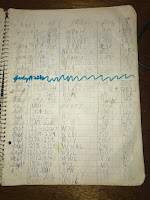
Original log book from
1971.
When I first got into radio, in 1971, I barely knew what I was doing. I had done some shortwave DXing with my GR-81, but that rig worked much better on the AM broadcast band than anywhere else. Just before labor day of 1971, I put up my first outdoor antenna. 

Previously, I had just used a spool of magnet wire strung around the ceiling of my attic bedroom. This was not a very good antenna. Just before school started in 1971, I bought a 25 foot roll of small speaker wire and unzipped it all. Soldering the two pieces together, this gave me 50 feet of antenna wire, which I strung out the window, across the garage and into a tree at the edge of the yard. 

I was eager to try this new antenna, so I proceeded to tune across the AM broadcast band that evening, and log each station I could. I started about 9 PM, and kept tuning until midnight. The next evening, I continued the process. 

Sep 3 log page.
That first night, I had started at the bottom of the band at worked my way upwards. The second evening, I continued upwards, but then reversed and went lower in frequency. This made more sense to me, and my later "countdowns" that I would make in subsequent years all started at the top of the broadcast band and continued toward the bottom. 

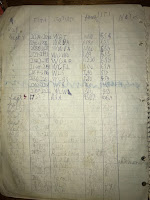
Sep 4 log page.
This event inspired me that for the next several years, I would try to do a "countdown" around Labor Day weekend. It marked the end of the summer, but also the beginning of the radio season. 

I remember it distinctly. I would sit patiently and wait for the AM stations to ID, generally at the top or bottom of the hour. If I got lucky, they would ID sooner. 

Hard to believe that event was over fifty years ago. 


Monday, May 3, 2021

Forty Years of Personal Computing - 6800 - The Need for Speed

The 1.0 MHz clock board, attached to the back
of the MP-A CPU board.
When I ordered my SWPTc 6800 Computer System, I was expecting a 1 MHz 6800 computer. It wasn't quite.

Yes, 1 MHz seems glacially slow by today's standards, but this was 1977! And the Motorola and MOS Technology chips of that time could access memory in a single clock cycle, so they were just as fast as the Intel or Zilog chips at twice the clock speed. (Those devices needed two clock cycles, minimum, to access memory and typically ran 2-5 MHz)

Perhaps as a cost-saving measure, the SWTPc MP-A board only has one crystal. This crystal connects to the MC14411 bit rate generator, which requires one specific frequency: 1.8432 MHz. The MC14411 contains a number of divisor networks to offer common bit rates for serial communication. 

The designers of the MP-A used one of those outputs to drive the MC6800 at exactly 0.9216 MHz through clock conditioning circuitry. The MC6800 has two clock inputs that must be non-overlapping. This required about three integrated circuits and about 20 discrete components to produce. (Motorola later developed the MC6875 chip for this purpose. The later MC6802 had an on-chip clock oscillator and driver)

Clever, perhaps, but disappointing. It meant that my computer was almost 8% slower than specified. 

Harsh Reality

Original crystal from my MP-A.
All this assumes you are start with a 1.8432 MHz crystal. In my unit, the crystal was actually 1.7971 MHz! This must have been another cost-saving measure. Perhaps the 1.8432 crystals weren't available, or perhaps they were more costly, since they substituted a unit that was 2.5% slower. 

This meant that I didn't have a 0.921 MHz computer, I had a 0.89 MHz computer. It was 11% slower than 1 MHz.

This would not do. 

First Modification

Changing the clock speed is actually a simple matter - one need only introduce a clock signal into the conditioning circuits that drive the MC6800. All you needed was a crystal oscillator and a 1 MHz crystal.

Close-up of the clock board.
I used a very simple circuit using two gates of a 7400 to create a very reliable oscillator. Even though this circuit was really simple, I wanted it to neatly attach to the CPU board. So, I etched a small circuit board. This was perhaps my second or third attempt at making a printed-circuit board, so it isn't pretty.

I masked the board by hand-painting etch resist. The lines are not very straight, and the lands have all different sizes. Most of the board was unetched and forms a ground plane that the crystal case is tied to. The result is very crude and rough.

Crude but functional etching.
The smallest drill bit I had was quite large for the pins, so the chips and other components don't rest very snugly, and are held in with solder blobs. All of the parts came used out of my electronics junk box, so they are different sizes. Only three wires connect to the MP-A: 5 volt power, ground, and the oscillator output. 

It worked!

I now had a computer which was 11% faster than stock. At the time, It really felt like I had improved the computer.

Overclocking

Having an external clock oscillator means you can experiment with different clock speeds. Some time circa 1980, it dawned on me that I might push the processor faster than 1 MHz

Now, the Motorola 6800 microprocessor line had different codes for different speeds. No letter indicated 1 MHz, and "A" indicated 1.5 MHz, and "B" was 2 MHz (eg an MC68A00 is 1.5 MHz, and MC68B00 is 2 MHz). This wasn't just for the processor, but it applied to all the peripheral devices in the line (MC6810, MC6820, MC6830, MC6850, etc). All of my components were 1 MHz only. Could it possibly work at higher speeds?

At an electronics shop, I found a surplus 2.01 MHz crystal cheap, so I figured I'd give it a try. I removed the 1.0 MHz crystal and installed the new unit.

It worked!

I ran that computer for a couple of years in that configuration, and I never had a problem. Those 1 MHz components could work at 2 MHz, although likely not through the entire 0 to 70 degrees C rating for commercial devices. 

This experience proved useful several years later at work, circa 1985. We had upgraded from the 4.77 MHz IBM PCs to 6 MHz IBM ATs. Of course, I opened up mine immediately and noted that the CPU crystal was 12 MHz and socketed. A trip down to the electronic surplus store netted several crystals at 16, 18 and 20 MHz. That IBM AT on my desk would not boot up at 10 MHz (using the 20 MHz crystal), but it ran just fine at 9 MHz. I made the same modification to several other colleague's computers as well to 8 or 9 MHz. We ran that way for years. And when it came time to turn them in, the original 12 MHz crystal was easily swapped back in.

Tuesday, March 28, 2017

Cycle 25

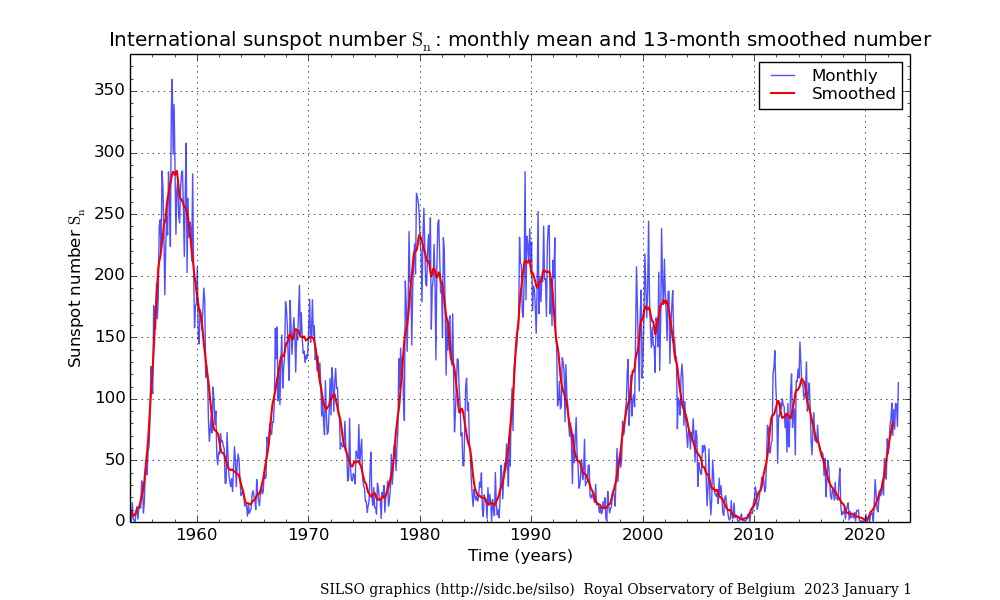
Smoothed SSN of the last six sunspot cycles.
Cycle 24 sucked.

I mean, really. Look at this graph. It's pretty clear that Cycle 24 was barely half as tall as the three cycles before it. It wasn't even as good as Cycle 20.

Smoothed SSN in Cycle 24 never made it over 82. The previous four cycles had several years over 100.

And that was after a sunspot low that lasted a couple of extra years before Cycle 24 began an upswing.

Now we're in that downward slide again. I know from experience that we're not seeing the end of the lull between cycles until the 2800 MHz solar flux gets down to 66 or 65. That's probably three years away. And then it will take a couple of years to build up. I'm thinking it will be about 2022 before Cycle 25 shows it's colors.

In the meantime, propagation on 160m and 80m should be pretty good in the winter months for the next several years.

I've told my wife, I want to be ready for Cycle 25. I want to have my antennas and station ready to rock when the sunspots come back.


Saturday, January 9, 2016

Project From a Friend - HF4B

HF4B Parts, after sitting out in the weather
for about 25 years.
I had a friend call me the other day. She was licensed about 25 years ago as N4VMN, but her license has since lapsed. In any case, she had some antennas that had been sitting out at beside her house in Marietta for quite a few years now -- she wanted to know if I might know anyone who could make use of them.

Well, I'm always interested in antenna projects, and I could certainly use some smaller antennas, so I said, sure, I could use them.

She had a slightly bent Ringo Ranger, and an old Butternut HF4B. Ah, the Butternut HF4B. I had one in Stone Mountain, GA from late 1987 until 1991, when I replaced it with a Cushcraft A3S.

N4VMN lived in another part of the same subdivision back then. She gotten licensed, bought a rig, and put up this antenna on a roof tower -- and she did it all without consulting me. While I was a bit disappointed I couldn't have given her advice, I was still impressed that she managed to do it all herself.

My experience had been that the Cushcraft A3S worked way better than the HF4B, but the Butternut was a solid performer.

The HF4B is a light-weight, trap-less tribander that uses large bow-tie shaped elements and a clever matching network. It supports 10, 15 and 20m, also also works on 12m. I never could get mine to match well on 12m, but it worked OK on the other bands. Being only two elements, it didn't offer a lot of gain, but had solid front to back. On difficulty in dealing with this antenna was it was so three-dimensional, as the bow-tie supports go three feet above and below the elements. Overall, though, it is pretty small. It can be easily turned with a small TV-type rotator.

N4VMN's antenna had spent a couple of decades outside next to the house. I expected after all this time it might need some repairs. The U-bolts are all shot, and will need to be replaced. The bow-tie supports were all bent, but look repairable. All of the bow-tie wires were broken or missing. The matching network tube supports were all bent, but look repairable. One of the element tubes had filled with water at some point, froze, and split about five inches from the center insulator. It might be repaired with a clamp or two, but replacement is probably a better option. The two fiberglass insulators seem to be in OK shape, although they need to have some of the weathering sanded off and protected with a nice coat of flat black paint (as I did on the R7000).

OK, this is going to be a project, but it looks like what remains is serviceable. I could definitely use a small tribander at the Walton County QTH, or even as a South-America facing antenna in Gwinnett County. I'll have to work out a 20-25 foot support to mount it on, eventually.

Wednesday, November 25, 2015

Forty Years of Ham Radio

My novice key.
I don't remember a lot about forty years ago. I don't remember much about taking the Novice exam, or the name or call of the fellow kind enough to give it to me. But I do remember, in November of 1975, receiving my Novice license. I became WN8WOY. It took months for me to get on the air in June of 1976. I kept that call until the FCC  issued me WB8WOY the next fall. I've told many of the details in my Novice Story.

I do remember ham radio being a lot different forty years ago. I was using all tube type gear. Although all-solid-state gear was available, it was rather uncommon until the early to mid-80s. I remember learning about transistors and tubes at the same time. It was easier and cheaper to generate RF using tubes, something that's still true today at the higher power levels.

I remember that I didn't have a clue what I was doing with ham radio. I had read a lot of 73 Magazine articles, but that didn't prepare me for actually being on the air, or how to put up reasonably effective antennas. In retrospect, I did a lot of dumb things, and perhaps missed some opportunities. But, I was having fun, and learning as I went along.

In those days, I remember working toward the goal of getting Worked All States. I believe I collected cards for about thirty states, but came nowhere close to working them all. Today, I've earned WAS on six bands, and worked all fifty states just last weekend in a contest.

I do remember I was quite shy about transmitting, and I did a lot of listening. Perhaps my first decade was much more about listening than transmitting.

I also remember I enjoyed building things. I'm glad I still do. Here's to forty more years of building, learning and enjoying ham radio.


Friday, September 18, 2015

The Venerable TS-430S

The Venerable TS-430S with AT-250 antenna tuner.
I realized earlier this week that my backup rig, the Kenwood TS-430S, turns 30 years old this month. Yup, I bought that rig back in September of 1985. For the next 16+ years, it would be my only HF rig.   I held on to that rig so long, by 1995, I was already calling it "venerable."

How I got to that point is an interesting story. My original Novice setup was an SB-301/SB-401 combo. In my second or third year of college, I sold my SB-401 to my brother Ben (now NJ8J). I still had the SB-301, and eventually I set it up in one of my college apartments. But I lacked a transmitter.

One summer, I attempted to rebuild my Novice transmitter using a 6GK6 and 6146 design published in the ARRL handbook. I added a lot of extras, like a built-in VFO and a KOX (key-operated-switch), with automatic T/R switching. (the VFO and KOX board were salvaged from a home-brew 40m QRP rig project that I assembled, but never could get to work) I never could get any output from that 6146 rig, and it chirped pretty badly.

Shortly after I finished college and moved into an apartment, I borrowed a friends FT-101E. The rig worked great. Because of my crummy antenna situation, I had a lot of trouble making contacts. Eventually my friend asked for his FT-101E back.

Since he bought the SB-401, my brother wasn't using a Heathkit DX-60B he had, so I borrowed it. I pulled the VFO out of the Novice transmitter, mounted it in a box with the KOX circuit board, a power supply and connectors for the DX-60B. This actually worked! I made a handful of contacts, but again the antenna situation really limited me.

In the summer of 1985, I moved to a new apartment much closer to work. It was two stories tall, and there were a number of trees about 30 feet away from the back. I took a couple of 100 foot spools of #26 wire wrap wire and strung them into the trees from my second-floor shack window, fed from the back of a crappy MFJ tuner with a balun. This formed a crude doublet.

For an operating table, I bought a door, placed it on two short two-drawer filing cabinets, and finished it with stain and polyurethane. I did a good job, because this door is still my operating table to this day in Gwinnett county.

I still needed a rig. I decided I didn't want to fool with tube-type radios any more. (That urge would return later) I wanted something that was all solid-state, had a direct-reading frequency display, supported the new WARC bands, and didn't cost terribly much.

At that time, the top contenders were the Kenwood TS-430S and the Yaesu FT-757GX. Both had a reasonable feature set, and were similarly priced around $600. I don't know what tipped me toward the Kenwood. In retrospect, based on what I know today, the FT-757GX had more features -- it does full QSK and has a built-in keyer, as well as supporting computer control via the CAT system. Computer control would be something I would pine for a few years later when I got into contesting.

Back in 1985, I wanted to get the best deal on my TS-430S, and I must have called a dozen different dealers for a price quote. The deal I found was a TS-430S for about $630, including the optional FM board. I placed the order with my credit card -- and this was perhaps the first time I would go into debt for my hobby.

I didn't do a lot of operating from that apartment, but I did enjoy the TS-430S. The crude doublet actually worked pretty well. I spent a fair amount of time on 30m, which was a relatively new back then, but I also hung out around the Novice bands on 80, 40 and 15m.

I moved to a house in Stone Mountain, GA, and the TS-430S was my main rig. My antennas progressed from a 300 long wire to a loop skywire, to a 125 foot doublet, eventually complemented by a Butternut HF4B beam on a roof tower that eventually gave way to a Cushcraft A3S. I started contesting in 1986 with CW Sweepstakes. The TS-430S paved the way for a whole lot of radio experience for me.

As a rig, the TS-430S is not a bad performer. There are two key deficiencies that were fixed by it's successor, the TS-440S: a) computer control, b) 100% duty cycle. The TS-440S adds a host of other features (100 memories, internal antenna tuner, selectable filter bandwidths, FSK, selectable AGC) Ironically, the TS-440S would be introduced at Dayton in 1986, just a few months after I bought the TS-430S.

CW performance is reasonable, depending on your expectations. There is no QSK, but the VOX operation from the key is quick and reliable. You can at least listen between words. AGC action is fast. The 500 Hz CW filter is a must-have.

SSB works well. VOX is fully adjustable, and the speech processor produces reasonable results on air. Choosing LSB or USB, though selects the slow AGC, which is annoyingly sluggish.

FM is interesting. I played around with 10m FM in the late 80s. There used to be a few guys in the Atlanta area that would hang out there back then. I think it may have faded, along with a lot of 2m FM.

Receiver performance is pretty good considering the up-conversion design and the vintage. There's certainly some front-end IMD, which you hear as a "sparkle" sound, especially on 10m when it is open during a contest. Usually hitting the attenuator knocks that out. The notch filter is pretty good, provided you are only dealing with one carrier. Of course, you have to adjust it manually. Noise blanker is one of the better ones.

Some contesters would be displeased with the manually-centered RIT. Never bothered me. IF Shift can sometimes help fight QRM -- but not in really crowded conditions.

This rig has some features I have rarely used. General Coverage Receive is one of them. Program scan has got to be the most useless of all -- since you have to manually hold the scan if you hear a signal.

I have made a handful of mods to my TS-430S. I did the 10 Hz frequency readout right away. (Why they didn't ship it from the factory this way, I'll never understand) Back when I used transverters for 2m, I enabled all-frequency transmit. Oh, and I did a simple mod that allows the YK-88C 500 Hz CW filter to be used for SSB narrow. This is useless for Phone, but makes easy work for RTTY.

Running RTTY is a mixed blessing. With the 500 Hz filter and the IF Shift adjusted, it does respectably on receive. The slow AGC is a little bit of a problem. Transmitting, though, should be limited to about 50-75 watts. Be sure to turn off the speech processor.

This rig has been with me at five different QTHs, as well as a host of Field Day operations. Although I long ago bought an MB-430 mobile mount bracket, I have never mounted it in a mobile.

Considering all the rapid changes in electronic and radio equipment in the late 70s to mid-80s, what with the transition from tubes to transistors to integrated circuits, plus the addition of new amateur bands -- it is amazing this rig still holds its own. I certainly didn't expect to be using it 30 years later.

Wednesday, August 12, 2015

AL-80A Repairs

AL-80A back in the operating position
Hard to believe, but it has been 10 years since I purchased the AL-80A. Archie, K4GA owned it before me, and it has served me well since that time. I added a step-start circuit a few years ago, and it's been doing well until April 2014.

I wrote earlier this year that the AL-80A had a failure that I traced down to an open 1.5 ohm 3 watt resistor on the meter board.

I finally got a replacement part from a source in China. (Well, it was cheap, but not fast) Installing the resistor was the easy part. While I had the amplifier away from the operating position, I decided I needed to do a couple of other updates.

Back in 2009, I added a glitch resistor, but I installed it on the wrong side of the B- line. It was between the capacitor bank and the rectifier, where it wasn't doing any good. I moved it into the B- line between the capacitor bank and the meter board.

Glitch resistor on the rectifier board.
My AL-80A rectifier board had a number of unused lands (likely for full-wave rectifier bridges in other amplifier designs), two of which were perfect for the glitch resistor. If you look carefully at the photo, you'll see a darker brown wire going from the capacitor bank land near the middle back to up the board. This goes to the far end of the glitch resistor.

The near end is hooked up to the brown wire that disappears off the bottom of the capacitor board, heading to the meter board. 

This made for a neat installation, and now that is is on the right side, it will actually do some good.

The other issue I addressed was the meter lighting. Because of a bad trip to Barbados long ago, the two grain of wheat bulbs were not affixed to the grid meter. One of them had been destroyed, and one other bulb on the multi-meter had burned out.

Grain of wheat bulbs like this are nearly impossible to find these days, plus I didn't want to have to fool with changing them when they burn out. So, I took a tip from the internet and replaced them with white LEDs. The LEDs were ones I had bought some time ago from Mouser.com. (Mouser part # 593-VAOL-5LWY4 - 4000 mcd standard white / clear LED -- these are still in stock, although you can get way brighter ones (35,000 mcd!) for less money) At 5mm (T 1-3/4) they were the perfect replacements for the old bulbs. 

The Grid Current meter did not have the holes drilled for the lamps. I held my breath and did this, using a very slow drill speed and working slowly. I didn't want to mess up the meters. Since the lamps are run from the internal 12 volts supply (actually about 13.5 volts), a 1.5 kiloohm resistor was wired in series to set the current at about 9 mA.

LEDs being glued in place on the meters.
The LEDs are glued to the back of the meter faces. Superglue would have been perfect, but unfortunately, I was out. I ended up using 30 minute epoxy, but this particular stuff is so old it was more like 240 minute epoxy.

I re-used the blue leads from the defunct grain of wheat bulb to wire in the negative terminal of the LEDs, and picked out some red wire for the positive side. I mounted the LEDs so the negative and positive corresponded to the terminals on the meter. Less chance of screwing something up.

Toughest part of this exercise was wrestling the meter board back into place. After buttoning it all up, it was time for the moment of truth.
Lighted meter faces.

Et voila, it works! The LEDs are not quite as diffuse a light as the grain of wheat bulbs, but they do a respectable job of indicating that the amplifier is turned on. 

It might be nice to get some more even illumination, but I'm pretty satisfied. Perhaps I might add some reflection inside the meters next time I need to open the box -- which hopefully, won't be for a while. Maybe in another five or six years.


Sunday, January 12, 2014

Straight Key Night 2014

Homebrew Transmitter and Receiver, ready for another
go at Straight Key Night in 2014
Last year, Straight Key Night (SKN) was kind of a bust for me. As I wrote then, I ran into trouble trying to key my 35+ year old electronic keyer to key the 40m "Novice" rig. This year, I got to operate SKN with no problems.

Despite having an entire year to figure it out, I left fixing the keyer to the last minute. Back in the summer, I had modified the keyer to use a 2N3906 to key the gate of a BS170. However, when I hooked it up to the rig, it wouldn't key -- oscillator problems again. It went back to the project shelf to be figured out later.

At some point, I took the keyer back to Gwinnett county to try to troubleshoot it there. But as fate would have it, I didn't have time to figure it out. Right before Christmas, I brought it back to Floyd county.

A bit of work with the mini-scope proved that the oscillator wasn't firing at all. It took a while until I found the source of the problem: one of the wires to the speed potentiometer had broken off, so the RC circuit was broken. Without it, there's no phase delay, and therefore, no oscillation.

Built in 1979, Mini-MOS keyer provides yeoman service again.
Great! This means I just hook it up to the rig and go right? Wrong. It appeared to work for a few seconds, but then it would continuously key. It was erratic. Troubleshooting it a bit more, and it seemed to work -- the keying signal would get to the gate of the BS170, but not beyond. At one point I thought maybe I had a bad MOSFET, so I pulled the BS170 out. (In the process, I ended up destroying the part - oops)

Pulled a 2N7000 out of the junk box. The 2N7000 and BS170 are pretty much the same part, although the pin-outs are different. Hook it up and it seems to be working great. I can see the keying on the gate on the 'scope, and the transmitter is happy. Unplug the scope probe, put the lid on, and ... it's locking up again.

Hmm. Take the lid off, put the probe on, and it works again. On a hunch, I pulled a 100k resistor out of the junk box and put it across the gate to ground. Working -- even with the probe removed. Ah ha! That's the problem. The gate of the 2N7000 (or BS170) wasn't being pulled back down to ground, so the floating leakage from the 2N3906 was just barely enough to keep it turned on. Adding the scope probe brought in just enough resistance (a few megaohms), to overcome that leakage.

All ready to go. After dining out with a church group on New Year's Eve, I managed to work seven stations all before the ball fell. Of course, I told them that I was cheating, using a 35+ year old keyer instead of a straight key. No one seemed to mind. I did find that my 7061.1 kHz crystal stopped working. Worked one more person on New Year's Day for a total of eight.

A great way to bring in the new year. I guess I'll submit mine as a check log....

Tuesday, September 17, 2013

Wayne Green, W2NSD/1, SK

I learned with some sadness today that Wayne Green passed away this weekend. He was 91. If you are new to amateur radio, you may not have heard of Wayne. He definitely made his mark.

Wayne was a pioneer. In the late 40s, he was an engineer at a television station, and he got into Radio Teletype (RTTY). Back in those days, this mean maintaining very noisy electromechanical monstrosities. Somewhere along the line, he started publishing a newsletter for other RTTY enthusiasts, eventually being hired by CQ Magazine. By the mid-50s, he was the editor of that publication, at least until he had a falling out with the publisher.

So, he started publishing his own amateur radio magazine: 73 Magazine. His initial goal was to get hams building equipment again. He focused on well-written, easy to construct articles. He must have done something right, because 73 continued publication until 2003.

Wayne was well known for his long, rambling editorials, his strong, sometimes bizarre opinions on just about any topic, and his irascible nature.

I've told my novice story, but I neglected to mention the part that Wayne had in it. My brother, NJ8J, started receiving 73 magazine in 1971 or 72. A couple of years later, I began reading these as well, whenever I could sneak them away from my brother. Back in those days, we would both read the print off the page -- absorbing every word. Christmas 1974, my brother gave me my own subscription to 73, starting with the January 1975 issue. (That way, he could read my copies, instead of me stealing his)

I learned virtually everything I knew about amateur radio back then from 73 or from the 1975 ARRL Handbook. I remember visiting the shack of a ham in Grafton, WV in the fall of 1974. Sadly, I don't remember his name or call. He let me make a few contacts on his Swan 500 -- one of the fellows asked me what I was interested in doing if I got licensed. I replied that I was interested in playing with Slow-Scan Television (SSTV). I knew a little bit about SSTV, because Wayne kept publishing articles about it. To date, though, I've never operated SSTV. (Although I did pick up a homebrew SSTV receiver -- replete with P7 phosphor tube -- for a song at a hamfest some 15 years ago. Perhaps another article)

Wayne Green was a visionary. After the Altair 8800 became available in the fall of 1974, Wayne set about creating a magazine for computer hobbyists. He founded Byte magazine. Unfortunately, his ex-wife and business partner made off with the magazine in the fall of 1975. Wayne responded by adding  the I/O section to 73 with the February 1976 issue. Then, he started a competing magazine, initially called Kilobyte, renamed to Kilobaud before the first issue in 1977.

Those articles in the I/O section convinced me to check out these newfangled microcomputers. In the fall of 1977, I used my paper route money to purchase a SWTPc 6800 computer system and CT-64 terminal. Those kits got me started with computers, which lead me to my current career. I have Wayne to thank for that.

73 was a thick publication in the late 70s and early 80s, with some issues closing on 400 pages. Five years later, it was much smaller, as Wayne was focused on the other computing-related publications in his small empire. Around 1984, he sold the entire lot to IDG, which was nearly a disaster for 73. A year later, he bought back the remnants of that magazine from IDG, and continued publishing until 2003. I'm still a mad at him for that -- I renewed my subscription that year for three years, only got seven issues and never got a refund.

I can't stay mad, though. I owe a lot of my interest in technology to the encouraging words Wayne wrote in his editorials so many years ago. Part of that spirit will always stay with me.

Rest in Peace, Wayne.

Saturday, June 23, 2012

Scratching the (Microsoft) Surface

Microsoft announced this week a new line of tablet computers running Windows. The announcement event had more than it's share of balky demos and unresponsive machines. The most curious thing, however, was the most distinctive feature of the Surface devices -- the embedded keyboard/cover. Although Microsoft had "hands-on" event, none of those present were actually permitted to try the keyboard. Add to this the fact that no pricing was announced and it just gives the entire event a forced feel -- like the products just weren't quite ready to announce.

John Gruber has perhaps the best analysis of this: "I presume Microsoft timed this event to jump ahead of anything Google might be announcing at their I/O conference next week — and the consensus seems to be that Google is going to announce much the same idea: their own Google-branded, Google-designed tablet that will put them in direct competition not just with Apple but with their own OS licensees."

Contrast this with Apple's announcement of the iPad. There were certainly plenty of rumours that Apple had been developing a tablet device. They had been circulating for years. In fact, the Apple rumour mill had gotten very tired of this story by the time of the announcement in January 2010. But Apple's announcement event was smooth and polished, full pricing information was given and pre-orders were taken within 60 days.

There's no doubt that the iPad has been a complete breakthrough product. And despite a host of challengers introduced in the last two years, none have really made an impact. Currently, there is no "tablet" market. Not yet. There's only an iPad market. 

I welcome Surface, just as I've welcomed the other iPad competitors. Competition is a good thing. When Windows Phone Series 7 was introduced during PDC '10, I thought it was a good thing. Frankly, I'm disappointed that it hasn't done better in the market. It's natural for any market to have three or four strong competitors, all pushing each other to produce better and better products and more attractive prices.

On this note, the personal computer market was a complete anomaly for over two decades. At first, it was dominated by the IBM PC. However, due to bad management, IBM had leaked enough technical details to allow their product to be copied, so the market became dominated with PC "clones." IBM tried to remedy this situation by introducing the Micro-channel Architecture, which required vendors to license certain technology in order to produce clones. (I fondly remember walking around COMDEX in the late 80's, finding some cool ISA hardware board, and then asking them if they had an MCA version available) But the market had already been wrested from IBM's hands, and placed in those of Microsoft, who's MS-DOS ran on all those clones.

Microsoft leveraged that OS monopoly into another, with Windows. Soon Microsoft dictated the hardware requirements to the clone makers, and stifled any upstart OS that threatened to emerge. Sure, there were competitors, such as Apple, who made arguably better computers, but they held an insignificant portion of the market. But it didn't last.

The problem with monopolies like this is they tend to stifle innovation. The best example is Microsoft itself -- with Internet Explorer. Microsoft recognized in late 1994 that the internet was a threat to their OS monopoly. They bought the Spyglass browser and turned it into Internet Explorer 1 in August 1995. There ensued a frenzy of innovation effort which brought us to IE 6 within six years. And then -- nothing for over five years. By 2001, Microsoft had achieved complete market dominance with an 85-90% market share in the browser space. Only when competition appeared again in the form of Mozilla and WebKit-based browsers did they again release new version of Internet Explorer. 

And, today, the browser market space is dominated by four strong competitors, each with 20-25% market share. That's a normal market.

There's too many writers in the computer press who are used to the anomaly -- with one competitor completely dominating the market. After all, it makes their job eaiser. All they have to do is follow the market dominator.

You'd think the press would embrace Apple's dominance in the tablet space. But no, it can't possibly be Apple. Apple was too long the beleaguered also-ran. By 1997, the press had given them up for dead. And there was certainly a lot of evidence for that. 

Apple proved it could successfully dominate the market with the iPod, another product many competitors tried unsuccessfully to compete with. Yet the press still looks to Microsoft.

After Apple announced the iPhone, Palm's Ed Colligan said, "PC guys are not going to just figure this out. They're not going to just walk in." Of course, the funny thing is -- they did. And not just once with iPhone, but a second time with Android. There's always room, even in a crowded market, for innovative products.

So, while I welcome the Surface to the market, I'm not really considering buying one. But I welcome the innovation it brings -- because this benefits all consumers. If nothing else, I can't wait for the next iPad...


Sunday, September 4, 2011

40 Years of Radio

September 3rd brought forth some fond memories for me. It stands out in my mind because of the evening of September 3rd, 1971. I received my first radio, a Heathkit GR-81, Christmas 1970. My first logbook entries are from January 9th, 1971, since it took us a while to build, especially considering that the band "A" coil we got with the kit was defective.

For many months, I used the GR-81 with nothing more than a bit of magnet wire wound around my attic bedroom. This worked, but it wasn't very effective. I listened to some local AM stations, and a few shortwave stations. The GR-81 wasn't very sensitive on band "D", where most of the shortwave broadcast bands are, so I concentrated on broadcast band DXing.

With the summer ending and school about to start, I managed to take a trip to the electronics store and buy some wire. I believe at that time, I bought a 25 foot spool of very small speaker cord and completely unzipped it. In my youthful frugalness, I had computed that this resulted in a cheaper acquisition of 50 feet of wire than buying a 50 foot spool outright.

That 50 feet of wire went out the window of my attic bedroom, across the roof of the garage, and was anchored to a climbable tree on the other side of the yard. In retrospect, it couldn't have been horribly effective -- it was too low to the ground, being only 10-15 feet high for most of it's length.

However, it was outdoors -- this being my first outdoor antenna. The results were pretty dramatic, compared with the indoor magnet wire. That evening, I started at the top end of the AM broadcast band (band "B" on the old GR-81), and worked my way toward the bottom. I must have logged about 40 different stations, many of them new.

This experience made an impression on me. For the next several years, I always attempted to do this AM "countdown" around labor day weekend. In addition to signaling the start of the school year, it was also the start of the radio season.

It's hard to believe it's been 40 years. I still have that radio, and it's still in good working condition. And somewhere in my files I have that first logbook.

Tuesday, March 3, 2009

Amateur Receivers circa 1950s

I recently read with some interest K2TQN's column about the HBR Receiver in the February issue of QST. I had never heard about this receiver until this column -- this design likely pre-dates my involvement in amateur radio by 10-15 years. 

When I got into ham radio in the early 1970s, the transceiver was beginning to come of age. In the 1960s, SSB had replaced AM as the primary mode for voice operation. Transmitters and receivers for SSB have many of the same circuits -- so it made sense to share these in a single box. Before then, most hams had separate transmitters and receivers.

Looking at the HBR receiver stage descriptions, the basic design seems foreign to our modern designs. Selectivity is provided by high-Q LC circuits in the low-frequency IF near 100 kHz. But such a low IF frequency wouldn't result in very good image rejection, so a first IF near 1700 kHz comes first. 

Now, in the 1950s and 1960s, the amateur bands were simpler. 160m was covered up with strong LORAN A signals and was virtually unusable. The 30, 17 and 12m bands hadn't been invented yet. So, most radios only needed to cover five bands. The HBR accomplishes this through plug-in coils. 

From a modern view, the lack of bandswitching and sharp IF filtering stand out. It's hard to imagine changing bands by opening up the top cover and swapping out coils -- particularly when a couple of them have potentially dangerous plate voltages on them. Perhaps a band switch was something of a luxury.

The IF filtering confuses me. My little 40m receiver has excellent IF selectivity from just four crystals. Hams in the 1950s could have built ladder filters in their receivers using crystals from 2-10 MHz. Although, I'm not sure the ladder filter design was invented until the 1970s. Perhaps the cost of the crystals was prohibitive -- crystals are often expensive, even today.

In the same issue of QST, there was a reference to an all-transistor receiver design by W2TGP. I looked up the article in the ARRL archive. It was very odd to see a rig using all PNP transistors, especially with a +12 volt supply. (The power goes to the emitters, and the collectors connect to ground -- somewhat opposite of today's convention)

Other than the use of transistors, the design is a curious mix of older and modern elements. The rig is small, so there's plenty of room for a bandswitch for five bands. Selectivity comes from a 455 kHz mechanical filter --  455 kHz is a bit low for good image rejection, so the first IF is around 2000 kHz. 

This transistor receiver likely outperformed the HBR in terms of selectivity, but the HBR likely had better dynamic range. The single-ended mixers of the 1950s can't hold a candle to even simple Gilbert-cell mixers today.


Saturday, January 31, 2009

My Novice Story

Seeing a link to the Novice Historical Society, I thought I would write my own Novice Story.

My start in radio was pretty conventional. If you have ever read So You Want To Be A Ham, the conventional entry in amateur radio comes after being a short-wave listener (SWL). You encounter other hams talking on the air, and eventually discover you can do more than just listen. Up until the widespread adoption of SSB, this was perhaps the most popular technique for discovering amateur radio.

I got started through my brother Ben (now NJ8J). Ben is five years older than I, and my mother always joked that I wanted to do everything he did. (And she was surprised when I often could) Christmas 1969 found us with our grandparents, and my Uncle Frank didn't know what to give us boys. He ended up getting Ben a Radio Shack Science Fair Globe Patrol receiver. This was a three transistor regenerative receiver, with AM broadcast and short wave bands. Frank, Ben and Dad built it, and my Grandfather had to step in and troubleshoot it (one reverse connected diode was enough to keep it from working).

Unfortunately for Frank, that was to be his last Christmas, he die tragically in April 1970, just short of age 25. But that little radio started something for both of us. Next Christmas, our parents bought us each Heathkit short-wave radios. Ben received a GR-64, and I a GR-81. We quickly became avid radio listeners.

The GR-81 wasn't that great on short-wave, so I initially concentrated a lot of AM broadcast DXing. (Best DX was WOAI in San Antonio, TX from Fairmont, WV) Ben took to listening to more short-wave broadcast, and he quickly found the ham bands as well. Ben had learned morse code in scouts, so he was "reading the mail" on the CW bands as well.

I had tried to learn morse, and about age 14, I had convinced myself that I was just one of those people who were incapable of mastering it. Then something amazing happened. Ben got his Novice license in February 1975. Of course, I always had to do everything he did, so naturally, I started to learn the code again. I bought and built a Heathkit HR-10B, and I began to practice by listening to W1AW and the Novice bands. By November 1975, I passed my Novice license, and was WN8WOY.

Getting licensed was one trick, actually getting on the air was another. By this time, I had realised that the HR-10B was not a great receiver for CW work -- the IF response was just too wide. Using money from my paper route, I bought a used Heathkit SB-301. The difference between the two receivers was amazing. You really could listen to just one signal -- especially after I bought the 400 Hz CW crystal filter.

The SB-301 kinda broke my budget for a few months, so it wasn't until June 1976 that I could afford a transmitter, in the form of a used Heathkit SB-401. Thus, I had the matching pair of Heathkit SB-series twins. Novices were no longer limited to crystal control, so the SB-401 wasn't a bad choice.

One problem being a Novice in those days -- you were limited to 75 watts power input to the final amplifier. The SB-401 could do about 180 watts, so I removed one tube and operated that way. During that summer, the FCC changed the rules to allow Novices up to 200 watts PEP output. Of course, I didn't find out about this until the fall. The FCC also decide to drop the distinctive Novice callsigns, so in the fall of 1976, I was now WB8WOY.

The summer of 1976, I did a fair amount of operating -- a handful of contacts every day. Mostly 40m, some 80m, and a few 15m. My antenna at first was a 40m inverted-V that was mounted on standoffs just underneath the eves of the house. The ends were within about a couple of feet of the ground, so this antenna really didn't work well. I also build a small L-network tuner for the long-wire I used for SWLing for use on 80m. It didn't work well, either. 

The Novice bands in the 1970s and even 80s were very different from today. Today, most evenings you could tune the CW bands and fail to hear more than a few CW QSOs, and none of them at slow speed. (Of course, if there's a contest or DXpedition active on a weekend, you'll hear lots of activity) Then, the Novice bands were a hotbed of activity, with slow speed QSOs going on all the time, every day.

In a year and a half on the air, before my Novice license expired, I made about 210 QSOs. That experience made a lasting impression on me. When I got my General class license in the summer of 1979, I often found myself operating in the Novice bands.